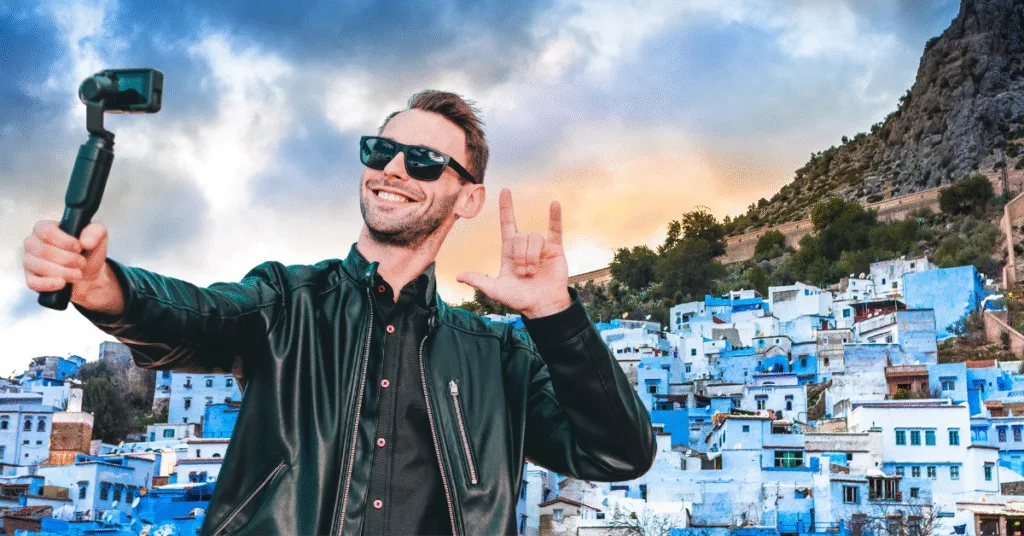
Good morning from Chefchaouen—aka “the Blue City”—tucked into Morocco’s Rif Mountains. We rolled out of bed to one of the coolest breakfast spots of our trip so far: a little riad rooftop with 360° views of blue-washed alleys and rugged peaks. Our room’s simple (heater included—mountain nights are chilly), the Wi-Fi is fast (a rare treat on our Morocco route), and the deal is even better: about $25 a night for two with breakfast. For budget travelers, that’s the magic combo—clean bed, hot tea, sunrise views.
From up here you see why Chefchaouen fills Instagram feeds. The rooftops are a watercolor of blues, creams, and terracotta, but it’s when you step down into the medina that the blue really hits you. Doorways, stairs, flower pots, entire passageways—it’s like walking through a dream filter set to “azure.”
Why is Chefchaouen so…blue?
We did a bit of reading, and there isn’t a single, confirmed reason. You’ll hear a few theories:
- Jewish refugees brought the tradition of blue after World War II.
- Blue helps repel mosquitos.
- Blue keeps alleys cooler under the summer sun.
- Or, most simply, it’s a way to attract travelers—and now the city’s identity is inseparable from that hue.
Whatever the origin, you won’t see anyone painting their home bright red. Blue is the uniform here.
First Impressions: Calm Lanes, Friendly Strays, Mountain Backdrop
We expected crowds because Chefchaouen is the postcard city, but in February the streets felt surprisingly calm. Maybe it’s the season. Cats lounge like they own the place, dogs nap on warmed stone steps. Many strays have ear tags—the city appears to be managing the population—and locals often feed or pet them. The vibe is easygoing, and unlike some markets elsewhere, shopkeepers here weren’t pushy. You can browse, admire, and keep moving with a smile and a “shukran.”
We wandered without a plan, because in Chefchaouen almost every street is photogenic. Painted steps, archways, little squares with fountains—it’s less about checking off sights and more about soaking up color and light.
Unexpected Architecture Lesson: Zawiyas and Sufism
Twice we happened upon lovely buildings labeled as zawiyas (Sufi lodges)—one dated 1835, another 1940. If Sufi culture catches your curiosity (we’d glimpsed whirling practices back in Turkey), these little detours add texture: spiritual micro-hubs tucked inside a mountain town.
The Main Square and the Kasbah
You’ll inevitably land in the main square (great for people-watching and mint tea) where many restaurants hide rooftop terraces with knockout views. Prices were reasonable: lunch for the two of us often came to around $12 total when we kept it simple with paninis and sandwiches. If you want a proper sight, step into the Kasbah. Built by Moulay Ali Ben Moussa, founder of Chefchaouen in 1471, it’s a modest, leafy fort with tower views over the blue maze and minarets. Entry was 60 MAD per person when we visited. Signage leans toward Arabic and Spanish, a nod to the city’s northern location and visitors from across the Strait.
Down by the River: Springs, Stone Walls, and Cold Feet (Literally)
From the medina we wandered to the spring-fed river just beyond the old city walls. In warm months, locals cool off here and some women still wash clothes along the channels, which double as a clever irrigation system. We noticed crates of oranges kept in flowing water—nature’s fridge. A word to the wise: watch your step when filming the scenery. One of us backed up mid-shot and went ankle-deep into the river—a chilly February wake-up call.
We followed the river downstream toward a less-touristy neighborhood with a school and lively streets. If you’re craving a breather from souvenir alleys, that wander is a gentle reset.
Lunch with a View
We stopped at Triana Café & Restaurant (also a hotel) for the views sweeping across the river valley. Meals here cost a bit more than our sandwich spots: 90 MAD for beef skewers, and another 90 MAD for a tuna steak burger the size of a small planet. Sauces had more kick than elsewhere we’ve tried—spicy fans, rejoice. We boxed up leftovers and shared some with street cats afterward; even the local dogs looked too comfy napping to bother.
Chasing the Sunset (Sort of)
Post-lunch, we took a rest back at the riad and then aimed for a viewpoint hike above the medina to catch sunset. The city walls climb the slopes, and there are a few ways up. We tried one rough path (read: rocks, not steps), then decided to switch to an easier road on the other side. Even without making it to the “official” viewpoint, the scenery is stunning: wave after wave of blue houses set against piney ridges and sky.
Souvenir Run (and What We Paid)
Back in town, we did a small souvenir haul:
- A large Moroccan teapot—quoted at 200 MAD, settled at 180 MAD. It’s sturdy enough to go directly on the flame.
- A copper bowl with engraved designs—first price 220 MAD, final price 190 MAD. (Seller scratched it to show the color doesn’t flake.)
- Two fridge magnets at 10 MAD each, including a tiny door that actually opens.
Were these the absolute best prices in town? Maybe, maybe not—but they felt fair, and the experience was friendly. If you’re new to haggling, think of it as a polite conversation with smiles and a “thank you” whether you buy or not.
Getting Around Morocco (Breezy, Honestly)
Chefchaouen was our final stop on this trip, and moving between cities was smoother than we expected. **Coaches, trains, shuttles—**all worked well. Roads were good, transfers easy. If you’re traveling on a tight budget, Morocco makes it possible: with $50/day for two, Chefchaouen is doable if you choose a basic riad (like ours at ~$25 with breakfast) and fill up on simple local lunches.
Practical Tips (from our day on the ground)
- When to go: February meant cooler temps, heaters at night, and lighter crowds. Summer can be hot; winter is mild but bring layers for evenings.
- Connectivity: Our riad’s Wi-Fi was fast and reliable—a pleasant surprise after some slower stays elsewhere.
- Language: Expect Arabic and Spanish on menus and signs; it’s common in the north. Basic French helps too, but Spanish may get you further here.
- Money: We paid 60 MAD per person for the Kasbah, ~12 USD total for simple lunches, 90 MAD for fancier mains at a view restaurant, and 180–190 MAD for larger souvenirs after a friendly haggle.
- Footwear: Streets can be steep and slick in spots, especially near the river. Wear grippy shoes and watch your step (learn from our unplanned plunge).
- Ethics with animals: Many strays are tagged and well-fed; offer scraps if you like, but don’t encourage chasing or crowding—split leftovers so cats don’t squabble.
- Rooftops: Always peek at restaurant or riad terraces; many have the best views in town for zero extra effort.
- Hikes: If you’re going for sunset viewpoints, start early. Some paths are rocky; there are easier road routes if you prefer.
Why Chefchaouen Works for Travelers
Chefchaouen gives you a high-aesthetic, low-stress city: mesmerizing color, mountain air, and easy meals. There are cultural touches (zawiyas, the Kasbah) and simple pleasures (tea in the square, river walks, terrace sunsets). You can splurge on a fancy view lunch or keep it ultra-budget with sandwiches and still feel full and happy. And even if you skip the Sahara (we did this time—we’ll be in the desert in our next destination), Chefchaouen alone delivers a highlight reel.
If you want more scenes like this in your feed, follow us on Instagram or Facebook—we share updates between videos. And if slow-travel, budget-friendly itineraries are your thing, join our newsletter for monthly tips, city cheat sheets, and honest budgets from the road.
FAQs
Is Chefchaouen good in winter?
Yes. Our February visit brought cool mornings/evenings (heaters helped) and lighter crowds. Days were comfortable for walking, and the softer light makes the blue alleys pop.
How much should I budget per day?
As a couple, we comfortably stayed under $50/day by choosing a $25 riad with breakfast, simple panini/sandwich lunches (~$12 for two), and saving “splurge” meals (like 90 MAD mains) for special views.
Are the streets hilly? What shoes do I need?
Yes—steep lanes and stairs are part of the charm. Wear closed shoes with good traction, especially if you’ll wander near the river or climb toward viewpoints.
Is the Kasbah worth it?
For 60 MAD per person, you get a quiet garden, tower views, and a bit of city history tied to 1471. We liked it—especially the perspective over the medina and mountains.
Why are signs in Spanish?
Chefchaouen sits close to Spain; Spanish visitors and influence are common in the north. We saw menus and signs in Arabic and Spanish more than French here.
What’s the deal with the blue paint—fact or legend?
There’s no definitive answer. Plausible reasons include a Jewish tradition, mosquito deterrence, cooling properties, and tourism branding. Whatever the source, the city maintains the blue consistently.
Any etiquette for the cats and dogs?
Most strays are tagged and well looked after. If you feed them, separate food to avoid fights, and don’t encourage chasing. Many locals already keep an eye on them.
Is the Wi-Fi workable for remote work?
In our riad: yes. We had fast, stable internet—better than in several other Moroccan stays. It varies by property, so check recent reviews.
Crédit: https://youtu.be/JiV63EkCrAo