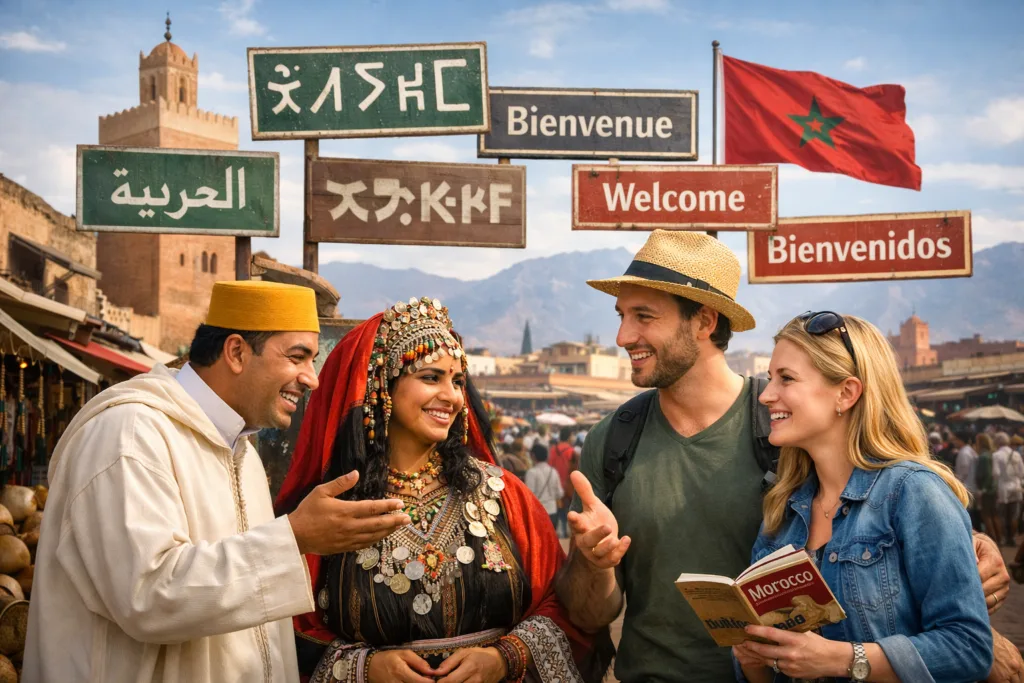
Morocco is a country of many voices, and that is part of what makes it so memorable for international travelers. In 2026, visitors will still hear a fascinating mix of Darija (Moroccan Arabic), Amazigh languages, French, Spanish, and growing amounts of English depending on where they go and who they meet. If you are planning a trip, understanding how these languages work in real life will help you move around more confidently, connect with locals more respectfully, and enjoy a richer experience from the medina to the mountains.
Official Moroccan sources make the picture clear. Article 5 of the 2011 Constitution recognizes Arabic and Amazigh as the country’s official languages. The Moroccan National Tourist Office explains that Darija is the language of everyday oral communication, while literary Arabic is used more in administrative contexts. The latest national census data from Morocco’s High Commission for Planning (HCP) also shows that Darija remains the dominant daily language, while Amazigh remains an essential part of Morocco’s cultural and linguistic identity.
For most tourists, the practical question is simple: what language should I expect to hear, and what should I use? The short answer is that basic English can work in many tourist settings, but French and a few polite Darija expressions will still take you much further. This guide explains everything you need to know before your trip, with updated 2026 information designed especially for international visitors.
| 2026 Snapshot | What Travelers Should Know |
|---|---|
| Official languages | Arabic and Amazigh are Morocco’s two official languages. |
| Most common everyday language | Darija is what you will hear most often in daily life, shops, taxis, cafés, and markets. |
| Amazigh presence | Amazigh languages remain especially visible in rural and mountain areas and in cultural identity across Morocco. |
| Best foreign language for tourists | French is still the most broadly useful foreign language in many everyday situations. |
| Can you travel with English only? | Yes in many tourist areas, especially among younger people and tourism professionals, but not everywhere. |
| Where Spanish helps | It is especially useful in northern and some southern parts of Morocco. |
| Smartest strategy | Use English when you can, keep a few French phrases ready, and learn simple Darija greetings. |
Official Languages of Morocco
Morocco’s linguistic identity starts with its constitutional framework. Under Article 5 of the 2011 Constitution, Arabic and Amazigh are the country’s official languages. For travelers, this matters because it explains why you may see Arabic script, Amazigh writing in Tifinagh, and different local speech patterns depending on the city or region.
That official recognition is not just symbolic. It reflects Morocco’s history as a meeting point between Arab, Amazigh, African, Mediterranean, and European influences. The result is a language landscape that feels dynamic rather than fixed. You are not visiting a country with only one linguistic reality. You are visiting one where language changes with setting, age group, profession, and geography.
Arabic: Literary Arabic and Everyday Darija
For visitors, one of the most important distinctions is the difference between Modern Standard Arabic and Darija. Literary Arabic is used in formal writing, official communication, some education, and administrative contexts. Darija, by contrast, is the language you will hear in the street, in taxis, at family-run shops, and during casual conversation.
According to Morocco’s High Commission for Planning, 91.9% of the population uses Darija in daily life. This year, that remains the clearest practical point for travelers: if you want to sound friendly and approachable, even a few Darija words will often be more useful than textbook Arabic. Darija also reflects Morocco’s layered history, blending Arabic with Amazigh, French, Spanish, and other influences over time.
You do not need to master Darija before your trip. But understanding that Darija is the spoken language of daily life will help you set realistic expectations. The Arabic you may know from apps, school, or other Arab countries will not always sound the same in Morocco.
Amazigh: A Living Indigenous Presence
Amazigh is not a single spoken variety but a family of languages deeply rooted in Morocco’s indigenous heritage. The HCP’s RGPH 2024 results show that 24.8% of the population uses Amazigh in daily life. Among the main expressions, Tachelhit is used by 14.2%, Tamazight by 7.4%, and Tarifit by 3.2%. These figures make Amazigh a major part of the country’s real linguistic map, not a marginal one.
Travelers are most likely to notice Amazigh more strongly in places such as the Atlas Mountains, the Souss region, parts of the Rif, and some rural communities. You may see road signs or public communication in Arabic and Tifinagh, or hear local people switch naturally between Darija and an Amazigh language depending on the context.
Even if you do not learn Amazigh phrases before your trip, simply recognizing its importance is a sign of cultural awareness. It also helps you better understand Morocco beyond the usual tourist clichés.
Foreign Languages Spoken in Morocco
Morocco’s language reality does not stop with Arabic and Amazigh. Foreign languages also play a major role, especially in tourism, higher education, business, transport, and urban life. For international tourists, this part is especially practical because it shapes what kind of communication will actually work during a trip.
French: Still the Most Useful Foreign Language
French remains highly important in Morocco. The Moroccan National Tourist Office says French is spoken and understood by almost all Moroccans, and the HCP reports that among literate people aged 10 and over, 57.7% can read and write French. In everyday travel terms, that means French is still extremely useful in cities, transport hubs, restaurants, pharmacies, banks, and many hotels.
If you speak French, you will usually find communication easier in formal or semi-formal settings. Menus, signs, packaging, and customer service often include French. Travelers who do not speak French can still manage, but knowing basic phrases such as greetings, numbers, and polite questions can make a noticeable difference.
English: Growing Fast, Especially in Tourism
English is clearly more visible than it was a generation ago. The HCP reports that among literate people aged 10 and over, 20.5% can read and write English. That does not mean one in five Moroccans will speak fluent conversational English with ease, but it does confirm the language’s growing presence in education, younger generations, digital business, and tourism services.
Actually, many international visitors are pleasantly surprised by how often English works in riads, guided tours, surf towns, major city centers, and popular destinations such as Marrakech, Chefchaouen, Essaouira, Tangier, and parts of Agadir. Still, outside tourism circles, English is less dependable than French. If your goal is smooth communication everywhere, English alone is possible but not always ideal.
Spanish and Other Languages
Spanish also matters more than many travelers expect. According to the Moroccan National Tourist Office, Spanish is widely spoken in northern and southern Morocco. This is especially relevant in parts of Tangier, Tetouan, Chefchaouen, and the former Spanish-influenced north, as well as in some southern areas.
Morocco’s 2024 census also notes the daily use of Hassania by 0.8% of the population, mainly associated with the country’s southern Saharan areas. Most tourists will not need it, but its presence is another reminder that Morocco’s language landscape is broader than many first-time visitors imagine.
Useful Phrases for Tourists in Morocco
Learning a few words before you travel can instantly improve your interactions. Locals usually appreciate the effort, even if your pronunciation is imperfect. In many cases, one greeting is enough to change the tone of an encounter and open a warmer exchange.
Basic Darija Phrases to Know
- Salam / As-salaam alaykum – Hello / Peace be upon you
- Labas? – Are you well?
- Iyyeh – Yes
- La – No
- Shhal? – How much?
- Afak – Please
- Shukran – Thank you
- Bslama – Goodbye
- Smeh lia – Excuse me / Sorry
- Fin…? – Where is…?
You do not need long sentences. A warm greeting, a polite thank you, and the ability to ask a price or direction will already help you navigate more comfortably.
Useful French Phrases for Travel Situations
- Bonjour – Hello
- S’il vous plaît – Please
- Merci – Thank you
- Combien ça coûte ? – How much does it cost?
- Où est la gare ? – Where is the train station?
- Je voudrais un taxi – I would like a taxi
- Je ne parle pas bien français – I do not speak French well
- Parlez-vous anglais ? – Do you speak English?
If you are unsure whether to learn Darija or French first, the best answer for short-term travelers is simple: learn a handful of Darija greetings for warmth and a few French survival phrases for logistics.
Language Etiquette and Cultural Considerations
Language in Morocco is not only about being understood. It is also about showing respect. Starting an interaction politely, greeting before asking for help, and using a calm tone often matters as much as vocabulary itself.
Which Language Should You Use?
- Darija: best for friendly everyday interactions, shopping, cafés, and local encounters.
- French: very useful in cities, transport, restaurants, customer service, and many practical travel situations.
- English: increasingly common in tourism, especially with younger people and tourism professionals.
- Spanish: especially helpful in the north and in some southern regions.
- Literary Arabic: mostly relevant in official, written, or administrative contexts rather than ordinary tourist conversation.
Politeness Matters More Than Perfect Grammar
One of the easiest ways to improve your travel experience is to greet people properly. Saying Salam, Bonjour, or Shukran shows courtesy and usually creates a friendlier atmosphere right away. In Morocco, that small effort often carries more weight than speaking with perfect grammar.
It also helps to be flexible. A conversation may begin in French, switch to simple English, and end with a Darija thank you. That fluidity is perfectly normal in Morocco.
Language Learning Resources for Travelers
You do not need a full language course to prepare for Morocco, but a little focused practice goes a long way. The best results usually come from combining a phrase app, a few pronunciation videos, and real-life exposure once you arrive.
Apps and Tools for Learning Darija
Not every language app offers a strong Moroccan Arabic course, so look specifically for Darija content rather than generic Arabic only. Phrase lists, YouTube pronunciation videos, flashcards, and travel podcasts can be enough for a first trip. Focus on greetings, numbers, directions, food, prices, and polite expressions.
Local Classes and Cultural Learning
If you are staying longer, local language schools and cultural centers can help you go deeper into Darija, Arabic, Amazigh, or French. They also make it easier to understand customs, gestures, and social codes that matter in daily life. That is one reason language learning naturally connects to broader Moroccan culture and can make your trip much more meaningful.
Frequently Asked Questions (FAQs)
What are the official languages of Morocco in 2026?
Morocco has two official languages in 2026: Arabic and Amazigh, as recognized by Article 5 of the 2011 Constitution.
What language do most people speak every day in Morocco?
The most widely used everyday language is Darija, also called Moroccan Arabic. According to HCP’s RGPH 2024 results, 91.9% of the population uses Darija in daily life.
Can I travel in Morocco using only English?
Yes, many tourists do, especially in major destinations and tourism businesses. However, English is not as universally practical as French, so knowing a few French or Darija phrases will make your trip easier.
Is French still useful in Morocco?
Very much so. French remains one of the most useful languages for travelers in cities and formal everyday situations, and HCP reports that 57.7% of literate people aged 10 and over can read and write it.
Where is Spanish most helpful in Morocco?
Spanish is especially helpful in northern Morocco and in some southern parts of the country, according to the Moroccan National Tourist Office.
What are the main Amazigh languages in Morocco?
The main Amazigh expressions are Tachelhit, Tamazight, and Tarifit. HCP’s 2024 census reports daily use at 14.2%, 7.4%, and 3.2% of the population respectively.
Which language should I use in official or administrative contexts?
Literary Arabic is used in administrative contexts, and French is also highly useful in many formal or semi-formal situations. For tourists, French is often the easiest bridge language.
What are a few polite words every tourist should learn?
A great starter set is Salam, Shukran, Afak, and Labas? in Darija, plus Bonjour and Merci in French.
Conclusion
Morocco’s language landscape is one of the country’s greatest cultural strengths. Darija gives daily life its rhythm, Amazigh anchors a deep indigenous heritage, French remains extremely practical, English is growing, and Spanish still has a clear regional role. For travelers, this means Morocco is not difficult to navigate, but it does reward curiosity and flexibility.
In 2026, the smartest approach is simple: travel with an open mind, rely on English where it works, keep some French ready for practical situations, and learn a few Darija greetings to show warmth and respect. That small effort can open doors, improve conversations, and make your journey through Morocco feel much more personal.
Official Moroccan Sources Used for This 2026 Update
- Article 5 of the 2011 Constitution of the Kingdom of Morocco
- High Commission for Planning (HCP), RGPH 2024 national synthesis note
- High Commission for Planning (HCP), 2024 note on daily use of Amazigh expressions
- Moroccan National Tourist Office, travel guidance on language and essential vocabulary
If this guide helped you plan your trip, subscribe to our newsletter by entering your email address in the designated field at the bottom of the page. You’ll receive more practical Morocco travel tips, destination ideas, and cultural insights for your next adventure.
FAQ
What are the official languages of Morocco in 2026?
Morocco has two official languages in 2026: Arabic and Amazigh, as recognized by Article 5 of the 2011 Constitution.
What language do most people speak every day in Morocco?
The most widely used everyday language is Darija, also called Moroccan Arabic. According to HCP’s RGPH 2024 results, 91.9% of the population uses Darija in daily life.
Can I travel in Morocco using only English?
Yes, many tourists do, especially in major destinations and tourism businesses. However, English is not as universally practical as French, so knowing a few French or Darija phrases will make your trip easier.
Is French still useful in Morocco?
Yes. French remains one of the most useful languages for travelers in cities and formal everyday situations, and HCP reports that 57.7% of literate people aged 10 and over can read and write it.
Where is Spanish most helpful in Morocco?
Spanish is especially helpful in northern Morocco and in some southern parts of the country, according to the Moroccan National Tourist Office.
What are the main Amazigh languages in Morocco?
The main Amazigh expressions are Tachelhit, Tamazight, and Tarifit. HCP’s 2024 census reports daily use at 14.2%, 7.4%, and 3.2% of the population respectively.
Which language should I use in official or administrative contexts?
Literary Arabic is used in administrative contexts, and French is also highly useful in many formal or semi-formal situations. For tourists, French is often the easiest bridge language.
What are a few polite words every tourist should learn?
A great starter set is Salam, Shukran, Afak, and Labas? in Darija, plus Bonjour and Merci in French.