Planning a trip to Morocco and wondering how to handle your money with confidence? In 2026, smart money planning is still one of the easiest ways to make your trip smoother, safer, and more enjoyable. This guide is designed for international tourists and brings together practical travel advice with source-based information from Bank Al-Maghrib, the Moroccan National Tourist Office, the Office des Changes, and Moroccan customs guidance.
From understanding the Moroccan dirham to knowing where to exchange cash, when to use cards, how much cash to carry, and what rules apply at the border, this page gives you the essentials without the confusion. Morocco is generally easy to navigate financially, but there are still local habits and regulations that visitors should know before they arrive.
You will also find updated answers to common traveler questions, practical budgeting tips, and advice on avoiding exchange headaches once you are on the ground. Whether you are visiting Marrakech, the Sahara, Fes, Rabat, Tangier, or the Atlantic coast, this guide will help you manage your travel money with far less stress.
| Key Point | Quick Take |
|---|---|
| Official currency | Morocco uses the Moroccan dirham, abbreviated as MAD and commonly written as DH. |
| Best approach in 2026 | Arrive with a bank card, withdraw or exchange a modest amount first, and keep some cash for daily purchases. |
| Cards vs cash | Cards work in many hotels, restaurants, and larger shops, but cash is still essential for taxis, souks, tips, and smaller businesses. |
| ATMs | ATMs are easy to find in major cities and tourist areas, but can be less convenient in remote regions. |
| Where to exchange | Use banks or reputable exchange offices. Airports and hotels are convenient, but rates are often less attractive. |
| Documents | Bring your passport when exchanging money, as exchange counters may request it. |
| Border rules | Large amounts of foreign currency may need to be declared, and Moroccan dirham export is limited. |
| Traveler tip | Keep exchange slips and avoid informal street exchanges. |
The Official Currency of Morocco
Morocco’s official currency is the Moroccan dirham (MAD). In everyday life, you will also see prices written as DH or Dhs. The dirham is divided into 100 centimes, and Bank Al-Maghrib is the institution responsible for issuing Moroccan banknotes and coins.
For travelers, the most important thing to remember is simple: pay in dirhams for everyday transactions. Even in very touristy places, foreign currencies such as euros, dollars, or pounds are not a reliable way to pay for taxis, snacks, market purchases, or tips. Morocco is much easier to navigate when you keep a supply of local cash with you.
Overview of the Moroccan Dirham (MAD)
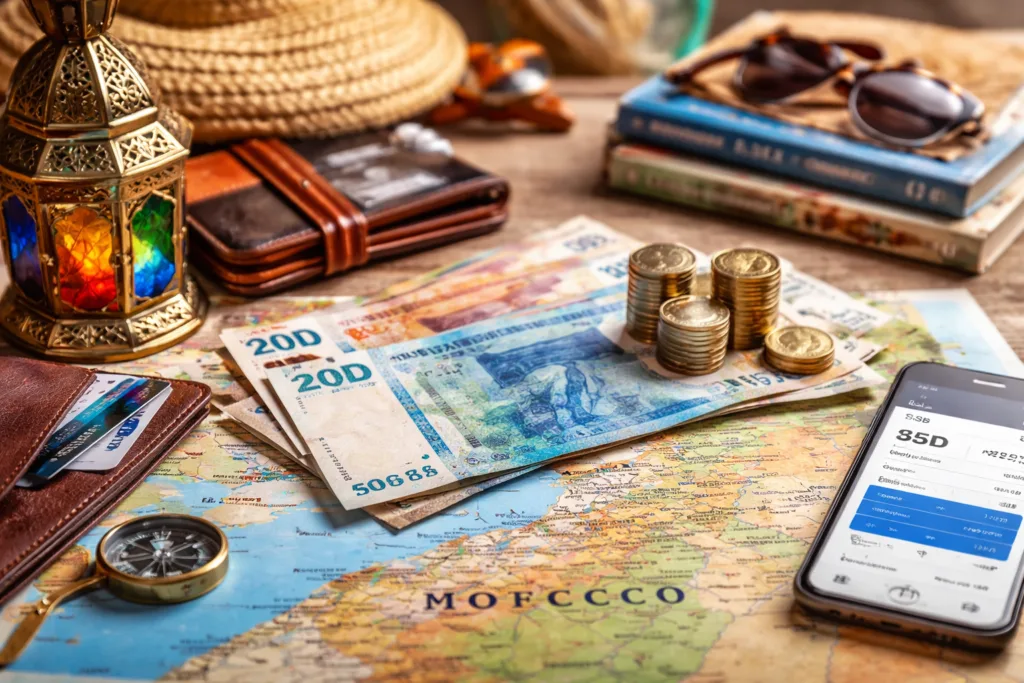
According to official Moroccan tourism and banking information, the banknotes most travelers will encounter are 20, 50, 100, and 200 dirhams. Coins in circulation include small centime coins and dirham coins, which are useful for cafés, public toilets, local shops, and small tips. Having smaller denominations is practical, especially during your first days in Morocco when you may be paying drivers, porters, or small street vendors.
If you withdraw a large note from an ATM, try to break it at a supermarket, modern café, or larger restaurant before heading into a medina or rural area. Small merchants often do not appreciate having to change a 200-dirham note for a very small purchase, especially early in the day.
Exchange Rates and Currency Symbols
Exchange rates move all the time, so it is better not to rely on a static number in a travel article. Instead, check the official daily reference rates published by Bank Al-Maghrib before your trip and again once you arrive. That gives you a more realistic benchmark when comparing rates at exchange offices or checking what your bank charged for an ATM withdrawal.
Because rates vary from day to day, experienced travelers usually avoid changing too much money at once. Exchange or withdraw enough for your first stage of the trip, then top up as needed. That approach keeps your cash exposure lower and makes it easier to adapt if your itinerary changes.
Where to Exchange Money in Morocco
Exchanging money in Morocco is generally straightforward, especially in airports, major cities, and established tourist destinations. The Moroccan National Tourist Office notes that airports, some hotels, banks, and city exchange offices all offer exchange services, making access fairly easy for visitors.
That said, convenience is not always the same thing as value. The smartest move is to exchange a small amount on arrival if necessary, then look for a reputable bank or well-known exchange office in the city center for larger amounts.
Banks and Exchange Offices
Banks and licensed exchange offices are the safest options for most tourists. They are transparent, formal, and much less risky than informal street offers. In busy destinations such as Marrakech, Casablanca, Rabat, Fes, Agadir, and Tangier, you will find plenty of official exchange points in commercial districts and tourist areas.
Before handing over your money, compare the posted rates and ask whether any commission applies. Even a small difference in rate can add up if you are exchanging a larger amount. Keep your passport with you, because official exchange counters may request it for the transaction.
It is also wise to keep your receipt. That is a simple habit that can help if you need to track your spending, question a transaction, or reconvert leftover funds later. More importantly, it shows that your exchange was done through a formal channel.
Currency Exchange at Airports and Hotels
Airport and hotel exchange desks are useful when you land late, arrive on a holiday, or simply need a small amount of dirhams right away for a taxi, snack, SIM card, or tip. They are not useless, but they are usually better for convenience than for the best value.
A good strategy is to exchange only a modest amount at the airport, enough to cover your arrival needs, then make a second exchange later at a bank or licensed city exchange office. That way, you balance convenience with a better rate.
Using Credit Cards and ATMs in Morocco
Morocco is easier to travel with than many first-time visitors expect. International cards are useful, and ATMs are common in the country’s urban and tourist networks. Still, Morocco remains a destination where cash matters more than in much of Western Europe or North America.
Availability of ATMs in Major Cities and Tourist Areas
The Moroccan National Tourist Office states that ATM bank machines are widespread throughout Morocco. In practice, that is true in city centers, airports, shopping areas, and popular destinations. You should not struggle to find an ATM in places such as Casablanca, Rabat, Marrakech, Fes, Tangier, Agadir, or Essaouira.
Currently, the more important question is not whether ATMs exist, but whether you should rely on them exclusively. In remote mountain villages, deep desert routes, and smaller rural towns, ATM access can be much less predictable. If part of your trip includes the Atlas Mountains, long road journeys, or the Sahara, withdraw cash in advance rather than waiting until the last minute.
Use ATMs attached to banks whenever possible. They are generally more secure, better maintained, and easier to return to if your card is retained or a transaction fails.
Credit Card Usage in Morocco: What You Need to Know
Official tourism guidance says that international credit cards such as Visa and MasterCard are accepted by most hotels, some restaurants, shops, and petrol stations. That reflects what many tourists experience on the ground: cards are practical for higher-value purchases, chain businesses, and formal hospitality services.
But do not assume card acceptance everywhere. Small riads, independent cafés, taxi drivers, medina stalls, local food counters, and neighborhood shops often prefer cash. Even when card payment is possible, cash can make small transactions faster and simpler.
If a card terminal offers a choice between your home currency and dirhams, choose dirhams. That often helps you avoid an unfavorable conversion set by the payment terminal. Also notify your bank before travel so withdrawals or purchases in Morocco are not flagged as suspicious.
Cash, Tipping, and Everyday Payments
Cash remains the backbone of daily spending in Morocco. Even travelers who use cards for hotels and bigger purchases usually carry cash every day for taxis, tips, snacks, market shopping, entry fees, and spontaneous purchases. The most comfortable travel setup is a mix of card access and local cash.
Local Tipping Practices
Tipping is common in Morocco, and having small change makes it much easier to handle these moments politely. In cafés, a few dirhams is usually enough. In restaurants, many travelers leave around 5% to 10% when service is not already included. Hotel porters, housekeeping staff, guides, and drivers often receive small tips depending on the level and length of service.
- Cafés: a few dirhams for table service
- Restaurants: around 5% to 10% if service is good and not already included
- Porters and hotel staff: a small cash tip per service
- Taxi drivers: rounding up is common for short rides
- Guides and drivers on excursions: tips depend on duration and service quality
Tip in dirhams rather than foreign currency. It is more useful for the person receiving it and avoids the need for them to exchange a small foreign note later.
Cash Payments vs. Card Payments in Everyday Transactions
In practical terms, Morocco is a card-friendly destination in formal tourism spaces, but still a cash-first destination in everyday local life. That matters a lot in medinas, markets, transport, beach towns, and roadside stops. If you enjoy bargaining, cash also keeps transactions simpler.
This year, travelers should think less in terms of “cash or card” and more in terms of “cash and card.” Use your card for convenience and security when appropriate, but carry enough dirhams for ordinary daily spending so you are never stuck searching for an ATM at an inconvenient moment.
Managing Your Money Safely in Morocco
Morocco is not unusually difficult from a money safety perspective, but the same common-sense travel rules apply. Spread your cash between wallet, hotel safe, and backup storage. Do not flash large amounts of money in crowded markets. Count cash discreetly, and avoid carrying your entire trip budget on you.
Security Tips for Handling Cash and Cards
- Use ATMs connected to banks rather than isolated machines when possible.
- Carry a second payment method in case one card fails or is blocked.
- Store emergency cash separately from your main wallet.
- Check receipts and card notifications after larger purchases.
- Break larger notes at supermarkets or established businesses before entering smaller markets.
If you use a mobile banking app, enable alerts before departure. That makes it much easier to spot a duplicate charge, an unexpected ATM fee, or a suspicious transaction while you are still traveling.
Avoiding Exchange Rate Scams and Poor Value
The easiest way to avoid money problems in Morocco is to stick to formal channels. That means banks, licensed exchange offices, reputable hotels, and bank-operated ATMs. Avoid street offers, vague promises of “special rates,” and any exchange that feels rushed or undocumented.
Compare rates, ask for the final amount before you confirm, and keep your receipt. That small routine protects you from confusion and helps you travel with more confidence.
Currency Rules and Border Limits
Money rules matter most at the border, especially if you are carrying large sums. Moroccan customs guidance indicates that foreign currency banknotes reaching the equivalent of 100,000 dirhams or more must be declared. If you are traveling with a large amount of cash, do not leave this to chance: prepare the paperwork and declare it properly on arrival or departure as required.
Moroccan dirhams are more restricted than foreign currencies for cross-border transport. For that reason, it is generally better to avoid leaving Morocco with large amounts of dirhams in your pocket. Spend what you need, keep your exchange paperwork, and reconvert the remainder through a formal channel before departure if necessary.
These rules exist to protect the financial system and to keep foreign exchange operations transparent. For ordinary tourists, the practical lesson is simple: do not carry unusually large cash sums without checking the latest customs guidance first.
Smart Money Tips for Tourists in Morocco
One of the best ways to feel financially comfortable in Morocco is to arrive with a simple plan. Bring a reliable bank card, carry a small amount of emergency cash in a major foreign currency if you wish, exchange or withdraw some dirhams when you arrive, and avoid relying on one single payment method.
A practical rhythm for many travelers is this: withdraw or exchange a moderate amount at first, use cards for hotels and larger purchases, keep cash for daily life, and top up before heading to rural or remote areas. That approach reduces both stress and unnecessary fees.
If you are planning a multi-city journey, do not assume every stop offers the same level of financial convenience. Casablanca and Marrakech are not the same as a remote desert camp, a mountain village, or a quiet surf town. Plan your cash needs according to your route, not just according to the country as a whole.
Frequently Asked Questions (FAQs)
Here are the most useful 2026 answers for travelers who want to handle money smoothly in Morocco.
What is the official currency of Morocco?
The official currency is the Moroccan dirham, usually written as MAD or DH. It is the currency you should expect to use for everyday spending across the country.
Can I pay in euros or US dollars in Morocco?
For daily travel spending, do not count on it. Some tourism businesses may discuss prices in euros, but ordinary transactions in Morocco are handled in dirhams.
Where is the best place to exchange money in Morocco?
Banks and reputable exchange offices are usually the best choice for transparency and fairer rates. Airports and hotels are convenient, but often less competitive.
Do I need my passport to exchange money?
Yes, you should carry it. Official Moroccan tourism guidance notes that exchange counters may require your passport for the transaction.
Are ATMs easy to find in Morocco?
Yes, especially in major cities and tourist areas. They are less dependable in remote areas, so withdraw in advance before desert, mountain, or rural travel.
Can I rely only on my card while traveling in Morocco?
No. Cards are useful, but cash is still essential for many everyday situations such as taxis, tips, markets, and small independent businesses.
Should I declare cash when entering Morocco?
If you are carrying foreign currency banknotes equivalent to 100,000 dirhams or more, customs declaration rules apply. Check the latest official customs information before you travel with large amounts.
Can I leave Morocco with Moroccan dirhams?
Moroccan dirhams are subject to export limits, so it is better not to leave with large amounts. Spend what you need, keep your receipts, and reconvert leftover funds through formal channels if necessary.
Conclusion
Managing money in Morocco is not complicated once you understand the basics: use dirhams for daily spending, combine cards with cash, rely on formal exchange channels, and plan ahead for remote areas. In 2026, the smartest travelers are not the ones carrying the most cash, but the ones who understand when and where each payment method works best.
With a little preparation, you can focus less on exchange counters and ATM searches and more on what really matters: wandering historic medinas, watching sunset over the dunes, enjoying Moroccan food, and moving through the country with confidence.
If you found this guide helpful, subscribe to our newsletter by entering your email address in the field at the bottom of the page. You will get more practical Morocco travel tips, destination inspiration, and updated advice for planning a smoother trip.
FAQ
What is the official currency of Morocco?
The official currency is the Moroccan dirham, usually written as MAD or DH. It is the currency used for everyday transactions across Morocco.
Can I pay in euros or US dollars in Morocco?
Not reliably for everyday travel spending. Some tourism businesses may quote prices in foreign currencies, but ordinary purchases are usually paid in dirhams.
Where is the best place to exchange money in Morocco?
Banks and reputable exchange offices are usually the best choice. Airports and hotels are convenient, but often offer less competitive rates.
Do I need my passport to exchange money?
Yes. Official Moroccan tourism guidance notes that exchange counters may require your passport for the transaction.
Are ATMs easy to find in Morocco?
Yes, especially in major cities and tourist areas. They can be less dependable in remote regions, so it is wise to withdraw cash in advance for rural, mountain, or desert travel.
Can I rely only on my card while traveling in Morocco?
No. Cards are useful for many hotels and larger businesses, but cash is still essential for taxis, tips, markets, and many small shops.
Should I declare cash when entering Morocco?
If you are carrying foreign currency banknotes equivalent to 100,000 dirhams or more, declaration rules apply. Check the latest official customs information before travel if you are carrying large sums.
Can I leave Morocco with Moroccan dirhams?
Moroccan dirhams are subject to export limits, so it is better not to leave with large amounts. Keep exchange receipts and reconvert leftover funds through formal channels if needed.