
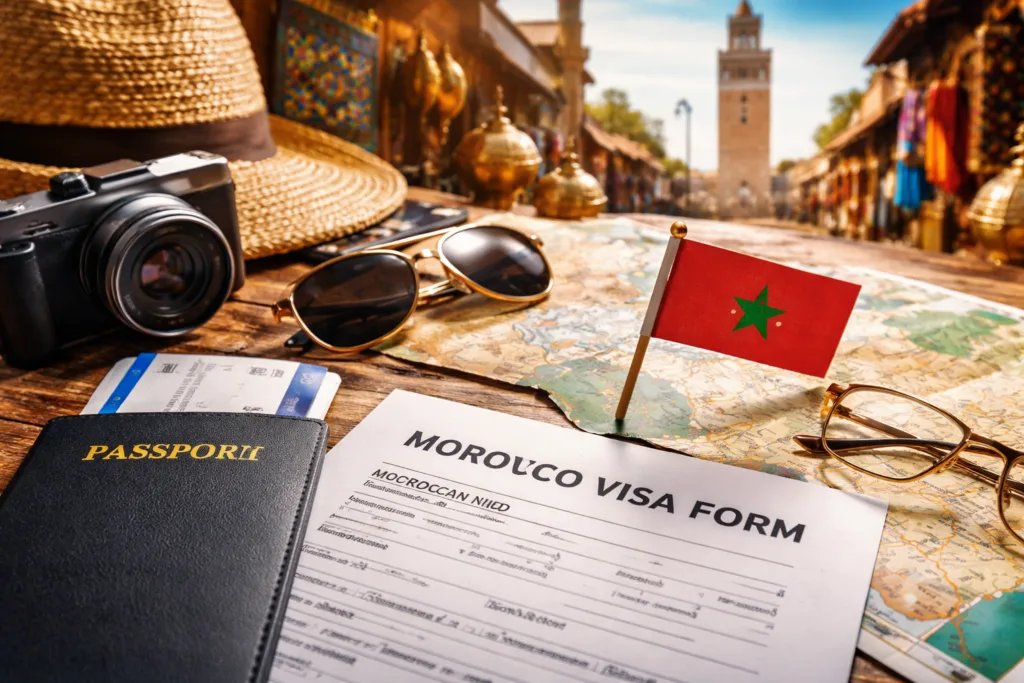
Morocco rewards travelers who prepare well. Border rules are usually straightforward, but they are not something to guess at the airport. In 2026, the smartest approach is to confirm whether your nationality is visa-exempt, whether you qualify for Morocco’s official eVisa system, and which supporting documents you may be asked to show on arrival. Based on guidance from Morocco’s Ministry of Foreign Affairs and the official Accès Maroc portal, this page explains the essentials in clear language so you can plan your trip with confidence and avoid last-minute surprises.
Whether you are coming for a city break in Marrakech, a coastal stay in Essaouira, or a wider itinerary across the kingdom, entry preparation is just as important as booking your flights and accommodation. This guide also connects you with practical next steps, including health tips, document checks, proof of funds, return-ticket questions, and the cultural awareness that helps a trip start smoothly from day one.
| 2026 Snapshot | What travelers should know |
|---|---|
| Visa-free travel | Many nationalities can enter Morocco for short tourist stays without a visa, often for up to 90 days, but you should still verify your own nationality before departure. |
| eVisa option | Eligible travelers can use the official Accès Maroc portal. The official eVisa guidance states a validity period of up to 180 days from issue for a single entry and a stay of up to 30 days. |
| Processing times | Standard eVisa processing is listed at 72 working hours in Morocco, while express processing is listed at 24 working hours, assuming the file is complete. |
| Arrival checks | Border officers may ask for your passport, eVisa or supporting residence/visa documents, a return ticket, proof of funds, and travel insurance depending on your case. |
| Health paperwork | Morocco’s Ministry of Foreign Affairs states that the passenger health form is no longer required for entry. |
| Best habit | Check your status on the official Moroccan portal before booking non-refundable plans, especially if you are not from a clearly visa-exempt country. |
Who Needs a Visa for Morocco?
The first thing to understand is that Morocco does not apply one universal rule to all visitors. Entry requirements depend on your nationality, the passport you hold, where you legally reside, and the purpose of your trip. For many leisure travelers, the process is refreshingly simple: a number of nationalities are exempt from a tourist visa for short stays, commonly up to 90 days. Official Moroccan consular information, for example, states that U.S. citizens may stay in Morocco for up to 90 days without a visa, and official consular pages for other countries show similar short-stay exemptions for many travelers.
That said, it is a mistake to assume that because your friend entered without a visa, you can do the same. Some travelers need to apply in advance, and some can use the official eVisa system instead of going through a consulate. The safest rule is simple: verify your exact eligibility on Morocco’s official channels before you fly. This matters even more if you hold residency in a country that is different from your nationality, or if you plan to travel on a schedule that leaves no room for delays.
If your stay is purely tourism-based, your options will usually fall into one of three categories: visa-exempt entry, official eVisa eligibility, or a traditional visa through a Moroccan embassy or consulate. Travelers coming for study, employment, journalism, volunteering, or longer residence should not rely on tourist-style assumptions. Those trips often require different documentation and different lead times.
Visa-free travelers: what “up to 90 days” really means
A visa exemption does not mean “show up with nothing.” It simply means you may not need to obtain a visa in advance for a short tourist stay. You should still travel with a passport in good condition, onward or return travel details, accommodation information, and enough funds for your stay. Airline staff may ask questions before boarding, and border officers can still request supporting proof if something about your trip looks unclear.
It is also wise to keep your itinerary realistic. If you say you are visiting for tourism, your bookings, return plans, and budget should make sense together. A three-week cultural trip through Marrakech, Fes, and the Sahara is easy to understand. A vague one-way plan with no hotel details and no visible means of support is much more likely to trigger questions. Good preparation is often the difference between a smooth arrival and an unnecessary delay at the border desk.
Morocco’s Official eVisa System Explained
For travelers who are not visa-exempt, Morocco’s official electronic visa system can make the process easier. The platform is handled through Accès Maroc, the Ministry of Foreign Affairs portal for visa and entry formalities. According to the official eVisa briefing note, the eVisa is an individual authorization issued online for certain foreign nationals who are otherwise subject to visa requirements.
The system matters because it creates a middle path between full visa exemption and a traditional consular application. Instead of automatically going to an embassy, some travelers can complete the process online if they fall into one of the eligible categories defined by Moroccan authorities.
The three main eVisa eligibility categories
The official briefing note groups eligible applicants into three broad categories. Category A covers nationals of a list of countries designated by Morocco. Category B covers foreign citizens who are subject to visa requirements but legally reside in certain countries such as EU states, the United States, Canada, the United Kingdom, Australia, Japan, Norway, New Zealand, the UAE, or Switzerland, provided they also hold a qualifying residence card or permit. Category C covers travelers who hold certain valid multiple-entry visas issued by approved countries, including Schengen states and several major destinations such as the United States, the United Kingdom, Canada, Ireland, Japan, Norway, and New Zealand.
This structure is especially useful for international travelers living abroad. A person whose nationality requires a visa may still qualify for Morocco’s eVisa because of their legal residence in an eligible country or because they hold a valid qualifying visa from one of the approved jurisdictions. In other words, nationality is only part of the story. Residence status and existing visas may also open the eVisa route.
Validity, stay length, and processing times
The official Accès Maroc briefing note says the maximum eVisa validity is 180 days from the date of issue, for a single entry and a stay not exceeding 30 days. It also says express processing is issued within 24 working hours in Morocco and standard processing within 72 working hours, provided the application is complete and accurate. That makes the eVisa useful, but not something you should leave until the final moment.
Currently, the practical takeaway is to apply early even if the official timeframes look short. Files can be delayed if scans are unclear, names do not match the passport exactly, or the wrong supporting document is uploaded. As with most border formalities, the shortest official timeline is not the same as a guaranteed travel-safe timeline. Give yourself a buffer and avoid building your departure around the most optimistic scenario.
Documents commonly required for an eVisa file
The official note says eVisa applicants should upload a recent color identity photo, a clear color copy of the ordinary passport identity and validity pages, and any residence card or qualifying visa required for their category. The guidance also notes that the accepted upload formats include JPG, JPEG, or PDF, with a file size limit that should not exceed 1 MB. Business travelers must also add documents proving the business purpose of the trip, such as an invitation or professional recommendation.
Just as important, Morocco’s official guidance says only ordinary passports are accepted for an electronic visa. Holders of other travel documents who still require a visa are directed to use the embassy or consulate route. That detail is easy to miss, but it matters. It can save travelers from wasting time on an online application that will not be accepted under their document type.
What You May Be Asked to Show on Arrival
Many travelers focus only on the visa itself, but entry decisions are not based on a single document. Even when you hold a valid eVisa, Moroccan border control can still verify the supporting evidence behind your trip. The official eVisa guidance explicitly says possession of an electronic visa does not create an irrevocable right of entry. Border authorities may refuse admission if the traveler does not meet the conditions or cannot produce the required evidence.
This is not unusual by international standards. It simply means that your paperwork should tell one coherent story. If you say you are entering for tourism, be ready to support that statement with travel details. Keep printed and digital copies of key documents so you are not dependent on airport Wi-Fi or a drained phone battery at the worst possible moment.
- Your passport, in the same form and number used for your application.
- Your eVisa printout or confirmation, if applicable.
- Your residence permit or supporting foreign visa, if your eVisa eligibility depended on one of those documents.
- A return or onward ticket.
- Proof that you can fund the trip.
- Travel insurance, especially hospital and repatriation cover for the stay.
The Accès Maroc note goes further and says eVisa travelers may be asked to show proof of livelihoods equal to more than 70 euros in cash per person and per day during the stay in Morocco, or the equivalent via an international bank card. That does not mean every tourist will face a detailed financial inspection. It does mean you should travel with credible financial proof rather than assuming your card balance or hotel booking alone will always be enough.
Passport, Health, and Airline Checks Before Departure
Your passport should be valid, legible, and in good physical condition. If you are using the eVisa system, the official Moroccan guidance says your ordinary passport must be valid for at least 90 days from the date of application. Beyond that formal minimum, sensible travelers should aim for a wider validity cushion so that airline checks, schedule changes, or longer-than-planned itineraries do not create avoidable stress.
For health formalities, one of the most helpful official updates is that Morocco’s Ministry of Foreign Affairs states that travelers no longer need to complete the passenger health form to enter the country. That removes one layer of arrival paperwork compared with earlier periods. Even so, you should still follow the standard good-travel habits that matter anywhere: carry personal medication in original packaging, keep prescription copies when relevant, and review medical coverage before you leave. For broader trip planning, our health tips page is worth reading alongside this entry guide.
Airlines are another key checkpoint. Carriers can deny boarding if your documents do not match the destination’s entry rules, because the airline may be responsible for transporting you back. So do not limit your planning to “What will happen in Morocco?” Also ask, “What will my airline expect before I even get on the plane?” A quick document review 48 hours before departure can prevent an expensive airport surprise.
Embassy Visa Applications, Longer Stays, and Special Cases
Not every traveler fits neatly into the visa-free or eVisa box. If your nationality is not exempt and you do not qualify for the official eVisa categories, the normal route is a Moroccan embassy or consulate. This is also often the appropriate channel for travelers using non-ordinary travel documents, as well as those whose purpose of travel goes beyond ordinary tourism.
Longer stays require extra caution. Tourists often assume they can solve residence, work, or study questions after they arrive, but that is the wrong mindset. Morocco clearly distinguishes between entry for tourism and longer-term residence or purpose-specific stays. The official eVisa note even states that the holder of an electronic visa may not apply for residency in the Kingdom through that document alone. If your plans could shift beyond tourism, resolve the visa category first and do not improvise later.
One of the best travel habits this year is to build flexibility into your timing. Do not schedule a tight business trip, a destination wedding, or a non-refundable desert circuit on the assumption that any pending visa issue will “probably work out.” Morocco is welcoming, but border and consular formalities still reward travelers who respect the process and prepare early.
What about extensions and overstays?
Travelers should never assume that overstaying is a harmless technicality. Once your permitted stay ends, you can face fines, delays, or more serious administrative trouble when leaving the country. If you believe you may need more time, deal with the issue well before your authorized stay expires and use official channels, not rumors from online forums or social media groups. Entry rules can be interpreted strictly when you are already out of status.
Equally important, do not confuse visa validity with permitted stay. Those are related but not identical ideas. A document may remain valid for a certain period from the date of issue, while the actual number of days you are allowed to remain in Morocco may be shorter. Reading that difference correctly is one of the easiest ways to avoid accidental overstays.
Smart Arrival Tips for a Smoother First Day in Morocco
A successful entry experience is not just about legal compliance. It is also about practical organization. Keep your hotel address accessible, know how you will reach your first accommodation, and carry enough immediate spending money for airport transport, SIM cards, or small purchases. If you arrive tired and disorganized after a long flight, even simple questions from officials can feel stressful.
It also helps to remember that first impressions matter in any country. Be polite, answer border questions directly, and avoid turning normal checks into a debate. Morocco is a culturally rich destination where courtesy goes a long way. Reading a little about the culture and customs of Morocco before you land can make the transition from airport formalities to daily travel much more comfortable.
If you are traveling with children, elderly relatives, or a mixed-nationality group, organize each person’s documents in advance. Family groups often assume everyone shares the same rule set, when in reality one member may be visa-exempt and another may require an eVisa or extra proof. A shared folder, printed backup copies, and clear role assignment for who carries what can save a lot of friction at the border.
Conclusion
For 2026, the best Morocco entry strategy is simple: verify your nationality status, use the official portal if you may qualify for an eVisa, prepare supporting documents as if you might be asked for them, and keep your travel story clear from booking to arrival. Morocco makes tourism accessible for many visitors, but smooth entry still depends on preparation, not assumptions.
If you treat visa and entry planning as part of the trip rather than an afterthought, you will arrive with more confidence and far less stress. That gives you more time to focus on what actually matters once you land: the medinas, the coast, the mountains, the desert, the food, and the warmth of Moroccan hospitality.
And once this page has helped you prepare, enter your email address in the newsletter field at the bottom of the page to subscribe for more practical Morocco travel advice, seasonal updates, and planning tips for destinations across the country.
FAQ
Do many tourists still enter Morocco without a visa?
Yes. Many nationalities can still enter Morocco for short tourist stays without a visa, often for up to 90 days. However, the exact rule depends on your nationality and travel document, so you should verify your own case through Morocco’s official channels before departure.
Who can use Morocco’s official eVisa system?
The official Accès Maroc system is available to certain travelers who are otherwise subject to visa requirements. Eligibility may depend on nationality, legal residence in an approved country, or holding a qualifying multiple-entry visa from an approved country such as a Schengen state, the United States, the United Kingdom, Canada, Ireland, Japan, Norway, or New Zealand.
How long does a Moroccan eVisa allow you to stay?
According to Morocco’s official eVisa guidance, the maximum eVisa validity is 180 days from the date of issue for a single entry, and the stay itself must not exceed 30 days.
How long does Morocco take to issue an eVisa?
The official guidance lists 24 working hours in Morocco for express processing and 72 working hours for standard processing, assuming the file is complete and accurate.
What documents can border officers ask for on arrival?
Depending on your case, officers may ask for your passport, eVisa printout, supporting residence or visa documents, a return ticket, proof that you can finance your stay, and insurance covering hospital care and repatriation.
Does Morocco still require a passenger health form?
No. Morocco’s Ministry of Foreign Affairs states that the passenger health form is no longer required for entry.
Can a valid eVisa guarantee entry into Morocco?
No. The official guidance says that holding an electronic visa does not create an irrevocable right of entry. Border control can still refuse admission if conditions are not met or supporting evidence is missing.
What is the biggest mistake travelers make with Morocco entry rules?
The most common mistake is assuming all travelers follow the same rule. Visa-free entry, eVisa eligibility, and consular visas depend on the traveler’s exact nationality, passport type, residence status, and reason for travel.