In 2026, understanding how tipping works in Morocco can make your trip feel smoother, more respectful, and much less awkward. Morocco is warm, service-minded, and famously hospitable, but tipping customs are not always obvious to first-time visitors. Some situations call for a few dirhams, some call for a percentage, and others do not require any tip at all. The key is not to think of tipping as a rigid rulebook. It is better understood as a practical way to acknowledge helpful service, save time in everyday interactions, and move through the country with confidence.
This guide explains who to tip, how much to tip, when tipping is appreciated, and when it is unnecessary. It also covers the real-world details that matter to travelers, including small cash tips, restaurant bills, hotel staff, taxis, guides, hammams, and rural excursions. If you want to avoid overpaying, under-tipping, or feeling pressured in tourist-heavy areas, this page will help you handle each moment calmly and politely.
Currently, the easiest rule is to keep small dirham notes with you, tip for personal service rather than every transaction, and check whether service is already included before adding extra.
| Situation | Practical tipping range | Best approach |
|---|---|---|
| Local cafés and simple restaurants | A few dirhams to around 5%–10% | Tip more for table service, less for counter service |
| Mid-range or upscale dining | Around 10% if service is not already included | Always check the bill before adding extra |
| Hotel porters and housekeeping | Around 10–30 dirhams depending on help | Use small notes and tip directly or leave clearly in the room |
| Taxi rides | Round up, or add 5–10 dirhams for helpful service | Most short city rides do not need a large tip |
| Guides and excursion drivers | Moderate to generous, depending on time and quality | Tip at the end of the service, especially for private tours |
| Supermarkets, chain stores, self-service places | Usually no tip | Pay the listed price and move on |
Understanding Tipping Culture in Morocco
Tipping in Morocco is common, but it is not the same as a fixed service charge culture where every interaction comes with a standard percentage. In many parts of daily life, especially where service is personal, direct, or informal, a small tip is seen as a simple sign of appreciation. That is why travelers often notice tipping around restaurants, hotels, taxis, guided visits, hammams, and luggage help. The expectation is usually practical rather than ceremonial: someone helped you personally, and a few dirhams says thank you.
At the same time, Morocco is not a place where you need to tip everyone for everything. You are not expected to scatter money constantly or reward every cashier, every shop visit, or every ordinary purchase. A lot depends on context. In local life, fixed-price businesses and self-service settings usually do not require a tip. Personalized service, however, often does. Once you understand that distinction, the whole subject becomes much easier.
It also helps to remember that Morocco welcomes very different kinds of travelers. Some people move through luxury hotels and private tours, while others stay in family-run guesthouses, use petit taxis, and eat in neighborhood cafés. The right tip should fit the setting. A sensible amount in a modest town café is not the same as a sensible amount in a high-end riad in Marrakech. Good tipping etiquette is not about being flashy. It is about being fair, calm, and observant.
Who to Tip in Morocco and How Much
Restaurants and Cafés
Restaurants are one of the most common places where travelers think about tipping. In small local cafés and simple restaurants, a few dirhams can be perfectly acceptable if someone brought your order to the table and looked after you. In mid-range restaurants, a practical range is often around 5% to 10% if service was good. In more polished or upscale places, around 10% is a comfortable rule of thumb unless the bill already includes service.
This year, the smartest restaurant habit is to read the bill before reaching for your wallet a second time. Some places may include service, while others do not. If nothing is included and the service was attentive, leaving something extra is appreciated. If the service was indifferent or the interaction was purely transactional, a smaller amount is perfectly reasonable. You do not need to tip as if you were following another country’s custom. You are responding to the actual service you received.
For coffee stops, juice bars, or quick snacks, tipping is lighter. If you ordered at the counter and carried everything yourself, there is usually no strong expectation. If table service was involved, a few dirhams is a nice gesture. The simplest rule is this: the more personal the service, the more natural a small tip feels.
Hotels, Riads, and Accommodation Staff
At Moroccan hotels or riads, tipping is less about one big amount and more about several small service moments. Porters who carry bags, housekeeping staff who keep your room comfortable, and door staff who help with arrivals or taxis are all people travelers often tip. A practical range for luggage help is around 10 to 20 dirhams depending on the number of bags, the level of help, and the type of property.
Housekeeping is often overlooked, but it is one of the most appreciated places to tip. Leaving 10 to 30 dirhams per day in a clearly visible place is a thoughtful gesture, especially if you are staying in a riad where service is personal and the team is small. If one person has gone out of their way to help with restaurant reservations, a late check-in, a lost item, or special arrangements, you can tip more generously than you would for routine service.
Concierge-level help sits in its own category. If someone books transport, solves a genuine problem, or organizes a smooth experience for you, 20 to 50 dirhams or more may feel appropriate depending on the value of the assistance. But again, keep it proportional. A good tip should feel appreciative, not theatrical.
Taxi Drivers and Transportation Services
For ordinary city taxi rides, rounding up is the most natural form of tipping. If the fare is small and the driver was straightforward, safe, and helpful, rounding to the next convenient amount is often enough. Many visitors overthink taxi tipping, but for short urban trips you usually do not need to add a large percentage. Simplicity works better.
Airport transfers, longer intercity transfers, or drivers who help with luggage and waiting are a different story. In those cases, adding 10 to 20 dirhams for an individual traveler, or more for a family or group, can feel fair. A private driver who spends several hours with you, handles changing plans well, or helps in practical ways may deserve more. The bigger the role, the more reasonable the tip becomes.
Transport also depends on context. A quick metered ride is not the same as a carefully managed transfer to a remote desert camp or mountain guesthouse. In one case, rounding up is enough. In the other, the driver may be part of a wider travel experience that involves timing, local knowledge, and extra effort. Match the tip to that reality.
Tour Guides, Day Tours, and Multi-Day Excursions
Guides are among the people most commonly tipped in Morocco because their work is intensely personal. A good guide is not only providing information. They are setting the pace, helping you avoid confusion, navigating crowds, answering cultural questions, and making the experience feel richer. If you book a private or small-group guide and the service is strong, tipping at the end is normal and appreciated.
For a half-day or full-day private tour, many travelers choose a moderate to generous cash tip depending on how valuable the experience felt. On multi-day tours, it often makes sense to tip at the end rather than day by day. If you are traveling with both a guide and a separate driver, think of them as two different roles. The guide’s tip reflects interpretation and care. The driver’s tip reflects safety, punctuality, smoothness, and support on the road.
Group size matters too. In a private setting, your tip may be larger because the experience is more tailored. In a large shared tour, your individual contribution can be smaller because the cost is distributed across many people. The point is not to chase a perfect formula. The point is to reward expertise, warmth, and effort in a way that fits the format of the experience.
Hammams, Spas, Photographers, Musicians, and Small Service Moments
Morocco has many small moments where tipping may come up unexpectedly. Hammams are a good example. If you receive hands-on service from an attendant, a small to moderate cash tip is common, with higher amounts in luxury spas and lower ones in traditional public settings. The same principle applies everywhere else: tip for direct service, not just for being present in the space.
Street performers, musicians, and informal photo opportunities require more discretion. If you knowingly engage, watch a performance up close, or ask for a photo, it is reasonable to offer something. If you did not request the interaction and do not want it, you are not obliged to participate. This matters in busy medinas where some encounters are staged around tourists. Be polite, smile, and decline clearly when needed.
Small assistance in daily life also counts. Someone carrying a heavy suitcase up a staircase, helping you find your platform, or guiding you through a confusing arrival may deserve a few dirhams. These are not major tips. They are practical thank-yous that keep travel interactions pleasant and respectful.
When Tipping Is Not Necessary
Supermarkets, Chain Stores, and Self-Service Places
There are also many situations where no tip is expected at all. Supermarkets, fixed-price chain stores, pharmacies, mall shops, and self-service food outlets generally fall into this category. You pay the listed amount and leave. Tipping here can feel unusual rather than helpful because the interaction is structured around fixed pricing, not personal service.
This is where understanding Moroccan etiquette really helps. Good manners are more important than forced generosity. A warm greeting, patience, and respectful communication often matter more than money in routine transactions. Not every moment needs a tip attached to it.
When a Request Feels Pushy or Unclear
If someone approaches you insistently in a tourist area and starts offering help you did not ask for, you do not have to reward that interaction. Morocco is friendly, but in busy places there can be moments when visitors feel pressured into paying for unsolicited directions, photos, or conversation. You are allowed to say no, keep walking, and stay polite.
The best response is calm and clear. Avoid arguing over very small sums if a situation is already tense, but do not assume every request for money is a formal tipping custom. Sometimes it is simply a tourist-area hustle. Confidence, courtesy, and common sense go a long way.
How to Tip Appropriately in Morocco
For 2026 travelers, the most practical rule is simple: tip in dirhams, carry small notes, and do not assume that every place can add a tip to a card payment. Morocco’s official tourism guidance notes that the Moroccan dirham is the local currency, that cash and credit cards are both used, and that cards are accepted more easily in hotels and larger businesses than in every small everyday setting. That matters because tips are still easiest, fastest, and most useful when given in cash.
Use Dirhams and Keep Small Notes
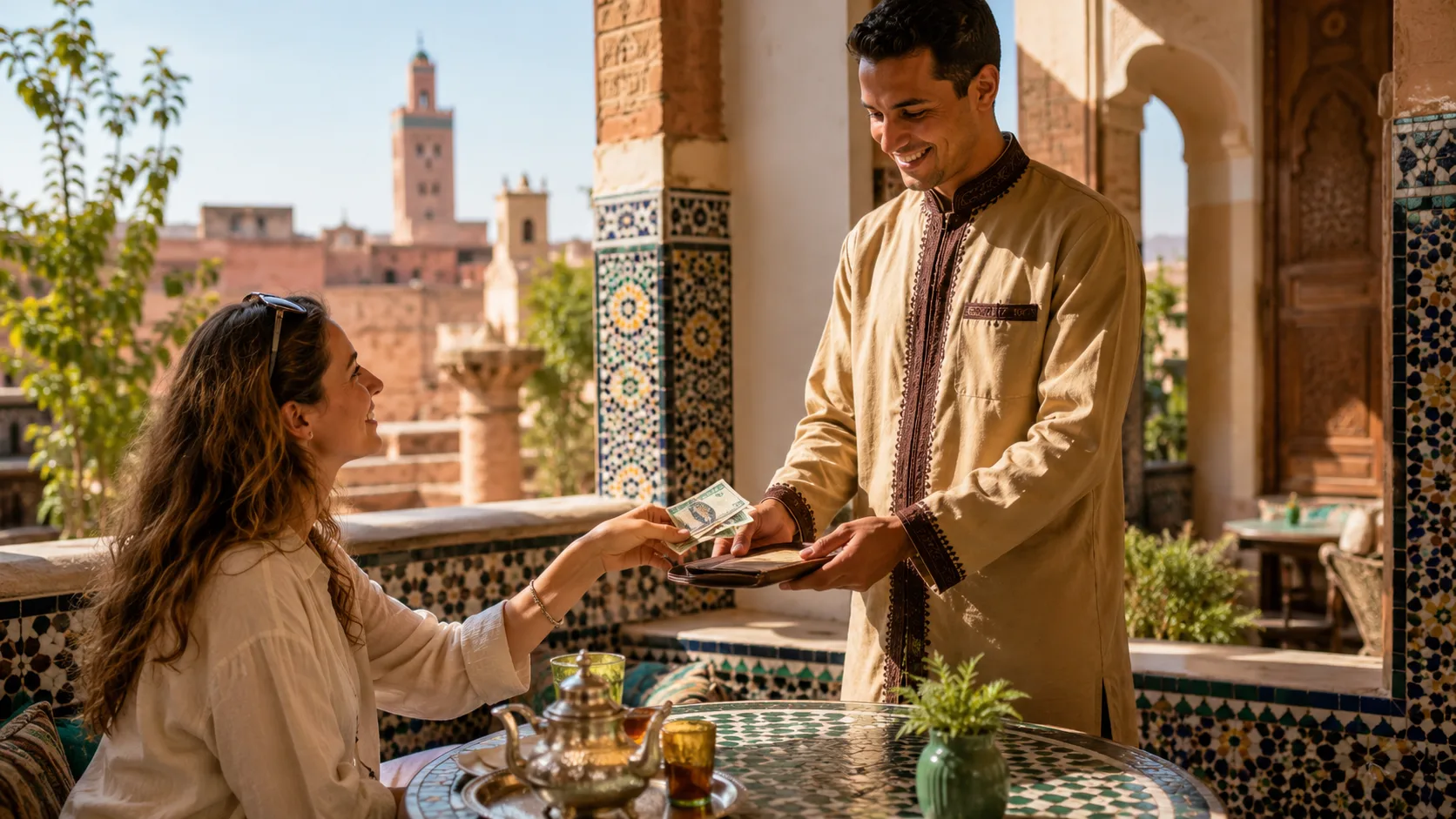
When you are carrying the right change, tipping becomes effortless. A handful of 10 and 20 dirham notes can solve most situations, while coins are useful for very small service moments. If all you have are large notes, even a generous intention can become awkward. The person helping you may not have change, and you may feel pushed into tipping more than you planned.
That is why it helps to think about tips as part of daily trip planning rather than as an afterthought. Keep a separate pocket or wallet section for small notes. Refill it after you exchange money, withdraw cash, or break a larger note at a restaurant. Good tipping etiquette is often just good cash management.
Cash, Cards, and Changing Money
When handling tips, use the Moroccan dirham rather than foreign currency. It is more practical for the person receiving it and avoids leaving someone with a small note they may need to exchange later. Morocco’s official tourism information also notes that if a place does not offer card payment, paying in dirhams is preferable, and that travelers can exchange currency at airports, hotels, and exchange offices in city tourist areas.
Cards remain useful for larger purchases and many formal businesses. Official Moroccan tourism information says ATMs are widespread and international Visa or Mastercard cards are accepted by most hotels and by some restaurants, shops, and petrol stations. But even when you can pay the main bill by card, the tip may still be easier to give in cash. That is especially true in cafés, with drivers, and during smaller informal service moments.
Hand the Tip Respectfully
The way you tip matters almost as much as the amount. Hand the money directly and discreetly whenever possible. Avoid theatrical gestures or treating the exchange like a performance. A simple thank you is enough, and if you want to be extra warm, you can say “Chokran bezzaf,” a common way of saying “thank you very much.”
Discretion is especially appreciated in hotels, riads, and guided settings. You are not trying to show off. You are simply recognizing good service. That quiet, respectful tone fits Morocco much better than dramatic tipping habits imported from elsewhere.
Tipping in Rural Areas and Smaller Towns
Tipping in smaller towns, villages, mountain areas, and non-touristy regions is often lighter than in major tourist centers. Service can be just as warm, sometimes warmer, but the tipping rhythm is usually softer and more local. That means you should avoid assuming big-city or luxury-destination tipping habits apply everywhere.
In rural cafés, family-run guesthouses, and simple roadside stops, modest tips are often enough. On the other hand, remote excursions can involve real effort: carrying supplies, managing animals, navigating rough roads, or supporting a long day outdoors. In those cases, a thoughtful tip at the end can be meaningful. What matters is reading the human effort behind the experience, not blindly following a city formula.
If you are ever unsure, let the level of service guide you. Was the help routine, brief, and basic? Keep the tip light. Was it personalized, difficult, or especially generous? Tip more. In quieter parts of Morocco, that balanced approach usually feels more respectful than trying to imitate a one-size-fits-all tipping chart.
Conclusion
In 2026, tipping in Morocco is best understood as a flexible social custom rather than a hard rule. A few dirhams can be enough in one place, while a fuller service experience may deserve more. When you check the bill, carry small notes, use local currency, and match your tip to the effort involved, you will almost always get it right.
If this guide helped you plan your trip with more confidence, enter your email address in the newsletter field at the bottom of this page. You will get more practical Morocco travel advice, cultural tips, and destination ideas to help you travel smarter and enjoy the country more deeply.
FAQ
Is tipping mandatory in Morocco?
No. Tipping is not a legal requirement, but it is widely appreciated in service situations where someone helps you directly. In practice, many travelers tip in restaurants, hotels, taxis, hammams, and on guided tours, while fixed-price shops and self-service places usually do not require anything extra.
How much should I tip in Moroccan restaurants?
In a simple local café or restaurant, a few dirhams may be enough if there was table service. In mid-range restaurants, around 5% to 10% is a practical range when service was good. In upscale places, around 10% is common unless service is already included on the bill.
Should I tip taxi drivers in Morocco?
For short city rides, rounding up the fare is often enough. If the driver helped with luggage, waited for you, handled a difficult route, or provided a longer transfer, adding 5 to 20 dirhams or more may feel fair depending on the situation.
What is a reasonable tip for hotel staff and riad teams?
Porters often receive around 10 to 20 dirhams depending on the number of bags and the level of help. Housekeeping can be tipped around 10 to 30 dirhams per day, especially in smaller riads where service is personal. If someone solves a real problem or provides special assistance, it is natural to tip more generously.
How much should I tip guides and excursion drivers?
There is no single national rate, but guides and drivers are among the most commonly tipped people in Morocco. For half-day and full-day tours, many travelers give a moderate to generous tip depending on the quality of the experience. On multi-day tours, it usually makes sense to tip at the end and to separate the guide’s tip from the driver’s tip if they are different people.
Should I tip in dirhams or in foreign currency?
Dirhams are better. They are immediately usable for the person receiving them and avoid the inconvenience of exchanging a small foreign note later. Small local notes are the easiest and most practical way to tip throughout Morocco.
Can I rely on card payments for tips in Morocco?
Not always. Cards are useful for hotels and many larger businesses, but cash remains the simplest method for tipping. Even if you pay the main bill by card, it is smart to keep small dirham notes for drivers, café staff, luggage help, guides, and day-to-day service moments.
What should I do if I only have large notes and need small cash for tipping?
Try to break large notes during ordinary purchases or after a meal, and keep the change separately for later use. Morocco’s official tourism guidance says travelers can exchange money at airports, hotels, and exchange offices in tourist areas, which makes it easier to prepare small bills for daily spending and tipping.