
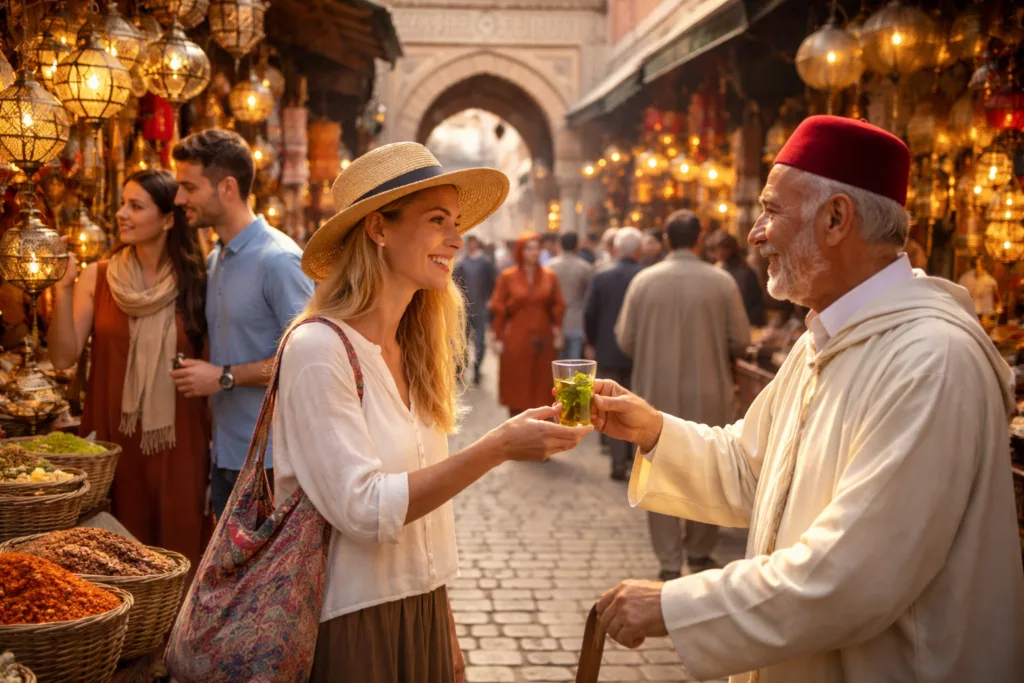
In 2026, understanding local etiquette is one of the easiest ways to make your trip to Morocco smoother, warmer, and more rewarding. Morocco is famously welcoming, but it is also a country where everyday courtesy matters: how you greet people, how you dress, how you behave in homes and religious spaces, and how you show patience in public all shape the kind of experience you will have. This year, travelers who adapt to local customs usually find that interactions become easier, invitations feel more genuine, and daily travel feels far less stressful.
This updated cultural guide explains the customs that matter most to international visitors in 2026, from greetings and dress expectations to dining manners, mosque etiquette, photography, tipping, and public behavior. Where useful, it also reflects practical guidance published by official Moroccan sources, such as the Moroccan National Tourism Office and the Fondation de la Mosquée Hassan II de Casablanca. The goal is simple: help you travel with confidence, avoid awkward mistakes, and show respect without feeling stiff or intimidated.
| 2026 key point | What travelers should do |
|---|---|
| Greetings | Greet first, smile, and use polite phrases like “Salam alaikum,” “shukran,” and “beslama.” With the opposite sex, let the local person decide whether to shake hands. |
| Dress | Choose modest, breathable clothing in cities and even more conservative outfits in villages, medinas, and religious places. Cover shoulders and knees for sacred sites. |
| Dining | Wash your hands before eating, use your right hand when sharing food, and wait for the host to begin. Accept tea or snacks graciously whenever possible. |
| Homes and mosques | Remove shoes when asked, bring a small gift if invited to a home, and follow official visitor rules carefully at the Hassan II Mosque in Casablanca. |
| Photography | Ask before photographing people, especially artisans, vendors, performers, families, and anyone in a private or devotional setting. |
| Tipping and shopping | Tip modestly but consistently for good service, and bargain politely in souks without turning it into a confrontation. |
| Ramadan and seasonal rhythm | Currently, the best approach is discretion during fasting hours, patience with slower daytime routines, and openness to the lively evening atmosphere. |
Why etiquette matters so much in Morocco
Morocco is not a difficult country for travelers, but it is a relationship-based one. People notice how you speak to them, how quickly you say thank you, how patient you are in small moments, and whether you observe the tone of a place before acting. In many destinations, tourists can move anonymously through hotels, taxis, and restaurants. In Morocco, especially in medinas, small towns, family-run guesthouses, and traditional neighborhoods, human interaction remains central to daily life.
This is why etiquette has real practical value. It does not only help you appear respectful; it can also affect the quality of the help you receive, the warmth of the welcome, and the trust people extend to you. A traveler who greets shopkeepers properly, dresses with cultural awareness, and behaves calmly in shared spaces is often treated less like a passing outsider and more like a considerate guest.
The official Moroccan tourism portal repeatedly presents hospitality as one of the country’s defining cultural traits, and that feels true on the ground. You may be offered directions, tea, conversation, or advice without asking. The right response is not suspicion or exaggerated enthusiasm, but composed appreciation. A simple thank you and a respectful tone go a long way.
Greetings and everyday politeness in 2026
Good manners in Morocco begin with greeting people before getting down to business. This is not just a formal extra. It is part of social rhythm. Walking up to a market stall and immediately asking the price without saying hello can sound abrupt. The more natural approach is to greet first, then continue.
According to the Moroccan National Tourism Office, Arabic and Amazigh are Morocco’s two official languages, while French is widely understood and Spanish is common in parts of the north and south. For travelers, that means you do not need perfect Darija to be polite, but learning a few words matters. “Salam alaikum” is a respectful greeting, “shukran” means thank you, and “beslama” is a warm way to say goodbye. Even very basic effort is usually appreciated.
Handshakes are common, but do not force them. Between men, a handshake is normal. Between men and women, it is best to let the woman take the lead. If she offers her hand, shake lightly and respectfully. If she does not, a smile, slight nod, and verbal greeting are perfectly appropriate. The same rule works in reverse for women greeting men.
Use a calm tone. Avoid pointing at people. If you need to call someone over, a softer downward hand gesture is more polite than an assertive finger point. In shops, cafés, taxis, and reception desks, patience is part of politeness. Things may not move at the speed some visitors expect, but visible impatience rarely helps.
What to wear in Morocco: respectful, practical, and climate-aware
Dress in Morocco is not about following a strict national uniform. Big cities like Casablanca, Rabat, Marrakech, and Tangier show a wide range of personal styles, from very modern to very traditional. Currently, tourists in major urban areas generally have more flexibility than they might expect. Still, modesty remains the safest and smartest default, especially if you want to move comfortably through medinas, residential neighborhoods, transport hubs, and rural areas without drawing unnecessary attention.
For women, the most practical formula is loose clothing that covers the shoulders, chest, and knees. Midi dresses, long skirts, linen trousers, loose shirts, and lightweight layers work very well. For men, T-shirts, shirts, and trousers or longer shorts are usually fine, but sleeveless tops and very short shorts feel out of place away from resort zones or beaches.
Swimwear belongs at the pool, beach, or private riad. Once you step back into the street, cover up again. This matters even in relaxed coastal areas. It is less about strict enforcement and more about reading the setting. A beachfront promenade, a fishing port, a family beach, and a hotel pool may all sit within the same city while following different unspoken expectations.
Religious places require extra care. The Fondation de la Mosquée Hassan II de Casablanca states that visitors should wear clothes that cover the shoulders, torso, and fall below the knees, and that shorts and sleeveless garments are not allowed during visits. Those official rules are useful beyond Casablanca too, because they reflect the respectful standard you should assume in sacred spaces across Morocco.
A scarf is helpful, not because foreign women must cover their hair everywhere, but because it can be useful in conservative settings, windy areas, desert sun, or moments when you simply want to dress a little more discreetly. It is one of the easiest items to carry and often one of the most useful.
Dining etiquette: sharing, tea, and the pace of the table
Meals in Morocco are often social rather than purely functional. Hospitality can appear quickly: mint tea at a shop, pastries in a family home, olives and bread before a meal, or an enthusiastic invitation to eat more than you planned. Even if you do not want everything offered, respond kindly. A blunt refusal can feel colder than intended.
If you are eating from a shared dish, use your right hand or your right hand with bread, and take food from the section closest to you rather than reaching across the whole plate. This is especially common with tagine, couscous, and shared family meals. If cutlery is provided, use it naturally. Morocco is not a museum. In many settings, locals themselves switch comfortably between fingers, bread, spoon, and fork depending on the dish and the context.
Handwashing before eating matters, especially in traditional settings. Sometimes water will be brought to the table or a sink indicated before the meal begins. Follow the lead of the host. It is also polite to wait until the host begins or invites everyone to start.
Tea carries meaning beyond refreshment. Being served mint tea is often an act of welcome, not just a beverage choice. You do not always have to accept, but accepting when you can helps slow the interaction in a good way. In Morocco, conversation often matters as much as the transaction.
If you are staying in a hotel, guesthouse, or riad where breakfast and dinner are served family-style, the same principles apply: greet staff, do not rush shared service, ask politely before taking extra items, and remember that warmth from staff should be answered with warmth in return.
Visiting Moroccan homes and religious places
If you are invited to a Moroccan home, treat it as a privilege. Family hospitality in Morocco can be generous, and even a short visit may include tea, fruit, sweets, or a full meal. Unless told otherwise, assume shoes may come off at the entrance or before stepping onto carpeted seating areas. Watch what others do and follow naturally.
Bringing a small gift is a good idea. Pastries, fruit, chocolates, or something for the household are safe choices. You do not need to bring anything expensive. The gesture matters more than the price. If children are present, warmth toward them is usually appreciated, but remain respectful and avoid overly familiar behavior.
For mosques, the rules are different. Most mosques in Morocco are not open for interior visits by non-Muslims. The major exception for most travelers is the Hassan II Mosque in Casablanca, where the official foundation organizes guided visits. This year, the published visitor rules remain clear: dress modestly, remove your shoes before entering, stay with the group, keep silence during the visit, and respect the designated route. The foundation also publishes special visit hours during Ramadan, which is worth checking before you go.
Even when you cannot enter a mosque, you can still admire the architecture from outside, pause respectfully near entrances, and avoid blocking worshippers. Do not treat active places of worship like open-air museum props. People are there to pray, gather, and reflect.
Photography, bargaining, tipping, and public behavior
Morocco is photogenic almost everywhere, but that does not make every scene public property. The most important rule is simple: ask before photographing people. This matters especially with artisans at work, market vendors, musicians, snake charmers, storytellers, henna artists, families, and elderly people. Some will happily agree. Some will refuse. Some may expect a small payment. The respectful response is to ask first and accept the answer.
Be extra discreet in cemeteries, shrines, prayer spaces, and moments of devotion. Even when photography is not formally banned, it may feel intrusive. If you are unsure, lower the camera and observe before acting. That pause often tells you more than a sign ever could.
Bargaining in souks is normal, but it should feel like a conversation, not a fight. Smile, keep your tone friendly, and accept that not every negotiation will end where you want. If the price does not work for you, a polite thank you and walk-away are far more effective than irritation. In many cases, the atmosphere of the exchange matters almost as much as the final amount.
Tipping remains part of daily travel culture. In cafés and casual restaurants, a small tip is appreciated. In restaurants with table service, many travelers round up or leave around 10 percent for good service. Porters, guides, drivers, and housekeeping staff are also commonly tipped. If you want a fuller breakdown, this page on leaving a tip covers practical situations in more detail.
Public behavior should stay measured. Loud arguments, visible drunkenness, aggressive flirting, and overt public affection all tend to read badly in many settings. Morocco’s social codes vary by place and generation, but discretion still travels well. If you are not sure how relaxed a place is, choose the more restrained version of your behavior first and adjust only if the setting clearly allows it.
Ramadan, holy days, and seasonal customs travelers should know in 2026
One of the most important cultural contexts for travelers is Ramadan. The Moroccan National Tourism Office describes it as a period marked by sharing and nightlife, and that is a useful summary. Daytime can feel quieter, slower, and more restrained, while evenings come alive after the fast is broken.
If your 2026 trip overlaps with Ramadan or nearby religious holidays, the best etiquette is discretion. Avoid eating, drinking, or smoking conspicuously in front of people who may be fasting, especially in less touristy areas. Many restaurants and hotels continue serving visitors, but daily routines can shift, opening hours may change, and transport or customer service may feel less predictable before sunset.
The reward for adapting is that Ramadan can also be one of the most atmospheric times to visit. Streets fill after dark, families gather, sweets and soups appear everywhere, and the evening mood often feels more communal than usual. The same principle applies to other holy days: accept that local rhythm may come before your timetable.
Friday also deserves mention. It is a normal workday in many parts of Morocco, but Friday noon remains an important prayer period. Around mosques, expect more movement before and after prayer. If you are planning visits, shopping, or road transfers, leaving a little extra flexibility in your schedule is wise.
Conclusion: how to be a respectful traveler in Morocco in 2026
For 2026, the smartest way to approach Moroccan etiquette is not to memorize dozens of rigid rules. It is to travel with observation, humility, and a willingness to adapt. Greet people before asking for help. Dress with awareness of the setting. Ask before taking someone’s photo. Accept hospitality graciously. Be discreet in religious spaces and during sensitive moments such as Ramadan. Most of all, pay attention to the mood of the place you are in.
Morocco welcomes millions of visitors, and it is perfectly possible to enjoy the country without becoming an expert in every local custom. But the travelers who leave the best impression are usually the ones who understand that courtesy here is not ornamental. It is part of the experience itself. When you meet Morocco halfway, Morocco often gives something memorable back.
FAQ
How should I greet people in Morocco in 2026?
Start with a greeting before asking a question or making a request. “Salam alaikum,” “shukran,” and “beslama” are useful phrases, and a smile matters. With the opposite sex, let the local person decide whether to offer a handshake first.
What should tourists wear in Morocco in 2026?
Modest clothing is the safest choice in most settings. In cities, relaxed modern outfits are common, but clothes that cover the shoulders and knees usually feel more comfortable and respectful, especially in medinas, villages, and religious places.
Do I need to cover my head in Morocco?
Not usually. Foreign women are not generally expected to cover their hair in daily life, but carrying a scarf is useful for conservative settings, sun, wind, and certain religious or ceremonial places.
Can non-Muslims visit mosques in Morocco?
Most mosques are not open for interior visits by non-Muslims. The main exception for most travelers is the Hassan II Mosque in Casablanca, where official guided tours are organized under published visitor rules and schedules.
What are the current visitor rules for the Hassan II Mosque?
According to the official foundation, visitors should wear clothing that covers the shoulders, torso, and knees, remove their shoes before entering, stay with the group, keep quiet during the visit, and respect the official route and timings.
Is it okay to take photos of people in Morocco?
Only after asking. Many people are happy to be photographed, but others prefer privacy or may expect a small fee, especially in busy tourist areas. Asking first is the most respectful approach.
How should I behave during Ramadan in Morocco in 2026?
Be discreet during fasting hours, especially in public places outside major tourist zones. Expect a slower daytime rhythm and livelier evenings after sunset, when many families and neighborhoods become especially active.
How much should I tip in Morocco?
Small tips are common in cafés, taxis, and for hotel assistance, while around 10 percent is often appreciated in restaurants with table service. The amount depends on the service and the setting, but polite, regular tipping is part of everyday travel culture.
Before you leave, subscribe to our newsletter by entering your email address in the designated field at the bottom of this page. It is the easiest way to get more practical Morocco travel advice, seasonal updates, and culture-focused tips for planning your trip well.