
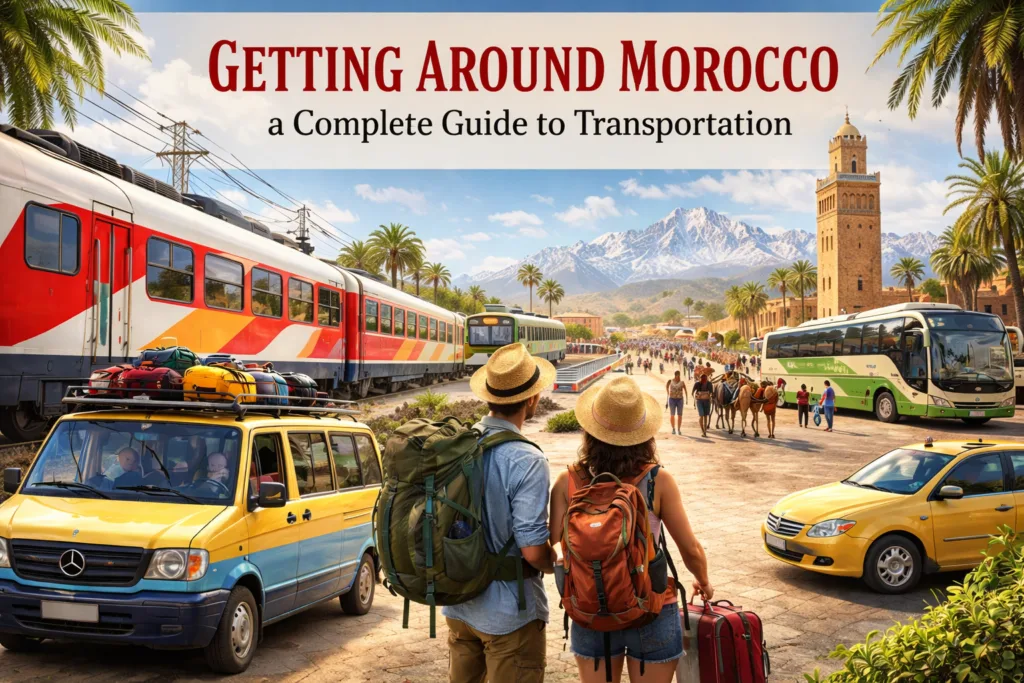
In 2026, getting around Morocco is easier, faster, and more flexible than many first-time visitors expect. The country now offers a strong mix of high-speed rail, classic trains, long-distance coaches, city taxis, tramways, domestic flights, and car rentals, which means you can build an itinerary that matches your budget, pace, and travel style.
Whether you are planning city breaks in Casablanca, Rabat, Tangier, and Marrakech, or heading deeper into the country for mountain villages, Atlantic beaches, and desert adventures, transportation in Morocco is no longer something to fear. The key is choosing the right option for each leg of your trip rather than relying on a single mode from start to finish.
This guide explains how to use trains, buses, taxis, rental cars, airports, and local urban transport with confidence. It also highlights where each option works best, what travelers should book ahead, and what practical habits make moving around the country smoother. If you want a broad overview before diving into the details, the summary table below gives you the essentials at a glance.
| Transport option | Best for | What to know |
|---|---|---|
| ONCF trains | Comfortable intercity travel | Currently the best choice for major city-to-city routes, especially along the Tangier–Kenitra–Rabat–Casablanca corridor and the classic network toward Marrakech and Fes. |
| Long-distance coaches | Places without rail service | A practical fallback for destinations beyond the train network, including many southern and rural routes. |
| Petit taxis | Short rides inside cities | Good for stations, hotels, medina edges, and quick point-to-point trips. |
| Grand taxis | Shared regional travel | Useful where rail or direct coach links are weak, but the experience is more local and less predictable. |
| Tramways | Urban transport in larger cities | Especially useful in Casablanca and Rabat-Salé for efficient daytime movement. |
| Domestic flights | Saving time on longer distances | Best when your itinerary is short and includes far-apart points such as the north, Atlantic coast, and deep south. |
| Rental cars | Flexibility and remote areas | Ideal for scenic routes, small towns, beaches, and mountain stops where public transport is limited. |
Public Transportation in Morocco
Morocco’s public transport is far more useful than many travelers assume before arriving. For major city pairs, the backbone is the ONCF rail network. For towns without rail access, long-distance coach companies fill the gap. Inside the biggest urban areas, taxis, buses, and tramways help you finish the last part of the journey.
The smartest way to think about transport in Morocco is by layers. Use trains for the fastest and most comfortable connections between the main cities. Use coaches for destinations the rail network does not reach. Use taxis or tramways once you are already inside the city. This simple approach usually saves both time and stress.
Official tourism guidance also makes an important point: Morocco gives travelers many ways to move around, from rail and road to airports and car rental. That variety is a real advantage for visitors because it allows you to mix convenience with budget-friendly choices instead of forcing the whole trip into one rigid formula.
Buses and Coaches: Local and Intercity Services
For routes outside the train network, coaches remain essential. They are one of the most practical ways to reach areas that are not directly served by ONCF, and they often connect stations, inland towns, and smaller tourist destinations. This is especially helpful if your itinerary includes places such as Agadir, certain mountain areas, or smaller regional stops between the major cities.
Comfort varies by operator and route, so it is wise to choose well-known companies when possible and to book ahead during holidays or busy weekends. Many travelers use coaches for medium and long distances, then switch to taxis for the final transfer to a hotel, riad, or busier old-town district where walking with luggage is not ideal.
For day-to-day city transport, local buses exist, but international tourists often find them less intuitive than trains, tramways, or taxis because routes and stops can be harder to decode on the spot. If you want the most straightforward urban experience, public buses are usually the backup option rather than the first one.
Trains: ONCF Network and Major Routes
For many visitors, trains are the easiest transport win in Morocco. ONCF lets travelers check schedules and buy tickets online for Al Boraq, Al Atlas, TNR, and Supratours connections, which makes pre-trip planning much simpler than it used to be. The system is especially useful if you are linking Casablanca, Rabat, Kenitra, Tangier, Fes, or Marrakech.
The high-speed Al Boraq service is the standout option on the northern axis. It connects Tangier, Kenitra, Rabat Agdal, and Casa Voyageurs, and it has changed the way travelers move between the north and the country’s central business hubs. For classic rail travel beyond that corridor, the conventional train network remains the most comfortable choice for long intercity trips. This year, booking in advance is one of the easiest ways to reduce friction, especially if you are arriving with a fixed hotel check-in or onward connection.
Another practical advantage is airport access. Casablanca Mohammed V Airport is linked into the rail system, which makes train travel a strong option for visitors heading toward central Casablanca or connecting onward through the national network. If rail is available for your route, it is usually the first option worth checking before flights or long road transfers.
Taxis in Morocco: What You Need to Know
Taxis are part of daily life in Morocco and, for tourists, they are often the most useful short-distance transport option. They matter most for airport arrivals, station transfers, city-center hops, and evenings when you want a direct ride back to your accommodation. They are also the mode visitors tend to use most often after trains.
Grand Taxis vs. Petit Taxis
Petit taxis are generally for trips within the city. They are the best choice for going from your hotel to a museum, from a train station to the medina gate, or from a restaurant back to your riad after dark. Grand taxis, by contrast, are better understood as shared or semi-shared vehicles for longer hops, edge-of-city routes, or regional travel where buses and trains are less direct.
Official tourism guidance also notes that taxis are easy to identify by color depending on the city, which is useful when you arrive somewhere new. In practice, that means you quickly learn what local taxis look like in Casablanca, Rabat, Tangier, Agadir, or Marrakech, and it becomes much easier to spot a legitimate vehicle rather than hesitating on the street.
Taxi Fares and How to Handle the Ride
- For city rides, petit taxis are usually the simplest choice because they are designed for short urban trips.
- Petit taxis are officially metered, so it is sensible to check that the meter is being used before the car gets moving.
- Grand taxi fares are more likely to be discussed in advance, especially when the route is regional, shared, or outside the normal city pattern.
- Have small cash ready for quick rides so you do not turn a short journey into a long exchange over change.
- If you are arriving late, very early, or with luggage, ask your accommodation to estimate the normal fare range or arrange a trusted pickup.
Taxi travel in Morocco is usually straightforward once you understand the split between short-distance petit taxis and longer-route grand taxis. The system can feel unfamiliar on your first day, but it becomes routine quickly. At the airport and in larger cities, organized taxi services are now easier to navigate than many visitors expect.
Renting a Car in Morocco
Renting a car is one of the best ways to experience Morocco beyond the main urban routes. It gives you freedom to stop at viewpoints, beaches, kasbahs, mountain villages, and roadside cafés without depending on fixed schedules. If your itinerary includes the Atlantic coast, the High Atlas, the road to the desert, or smaller towns between major destinations, self-driving can turn logistics into part of the adventure.
Requirements for Renting a Car
You should arrive with a valid driver’s license, your passport, and the payment card required by the rental company. Many travelers also carry an International Driving Permit for extra clarity, especially when renting from larger agencies or if their home license is not in a language that staff can easily process. Booking ahead usually gives you more choice and better pickup timing, especially at airports.
Morocco’s official tourism information also notes two important practical details for drivers: vehicles drive on the right, and road signs are typically in Arabic and French. That combination is easy enough for many travelers, but it is another reason to preview your route before departure instead of improvising once you are already in traffic.
Driving in Morocco: Rules and Real-World Tips
Driving conditions can shift quickly between modern highways, busy city avenues, mountain roads, and village streets. The main highways are usually the easiest part of the experience, while dense city centers require more patience, slower reactions, and a willingness to let local rhythm set the pace. Parking can be the bigger challenge than driving itself in crowded urban zones.
If you plan to rent a car, use it where it adds real value. It is excellent for scenic loops and rural flexibility, but it is often unnecessary once you are already based in cities like Rabat, Casablanca, or Marrakech, where trains, taxis, and tramways may be more convenient. A mixed strategy works well: train between big cities, then car rental only for the segment where freedom matters most.
Other Transportation Options
Morocco has a few extra transport layers that can improve your trip depending on where you go. They are not always the backbone of the itinerary, but they can be useful for local sightseeing, short leisure rides, or filling gaps between bigger transport steps.
Tramways, Tourist Buses, and Special Local Options
Tramways are especially valuable in Casablanca and Rabat-Salé, where they offer one of the easiest ways to move through the city during the day without dealing with road traffic. For visitors who want a cleaner, more predictable urban ride than taxis, the tram can be the most comfortable choice for sightseeing areas, shopping districts, and business neighborhoods.
Morocco’s official tourism information also highlights a few more local experiences: sightseeing buses in Marrakech and Tangier, small tourist trains in Agadir and Ifrane, carriage rides for short exploratory outings, and even taxi bikes in Rabat. These are not usually core transport for a full itinerary, but they can add convenience or charm once you are already settled in a destination.
When Walking Is Better Than Riding
Not every Moroccan journey should happen by vehicle. In medinas, kasbah areas, and beachfront promenades, walking is often the better option. Many historic quarters are better experienced on foot because they are dense, lively, and full of visual detail that you miss when rushing between fixed points. Transport gets you close; walking is often what lets you actually feel the place.
The trick is to combine modes wisely. Take a taxi to the medina gate, then walk. Use the tram to cross the city, then finish the last stretch on foot. Ride the train to the major destination, then rely on local transport only when you need it. Morocco rewards travelers who stay flexible rather than overly rigid.
Navigating Moroccan Airports and Flights
If your itinerary covers far-apart regions and your time is limited, domestic flights can be worth considering. Official tourism guidance points to frequent internal air connections through carriers such as Royal Air Maroc, Air Arabia, and Ryanair, while airport information is managed through ONDA, which also lists access, facilities, and transport services for individual airports.
Major Airports in Morocco
Casablanca Mohammed V remains the main aviation gateway for many international travelers, but Marrakech Menara, Rabat-Salé, Fes, Tangier, Agadir, and other airports can play an important role depending on your route. One of the most useful habits for planning is to think in terms of entry and exit strategy. You do not always need to arrive and depart through the same city if an open-jaw itinerary saves time on the ground.
At airport level, ONDA pages are particularly useful because they show practical arrival information such as taxi and bus services, parking, access, and traveler facilities. That matters because airports in Morocco are not all identical. Before you land, it is worth checking the exact airport page rather than assuming every arrival works the same way.
Domestic Flights and When They Make Sense
- Use flights when your itinerary is short and includes distant points that would otherwise take a full day by road.
- Trains are often better for the northern and central urban corridor, where rail is efficient and city-center to city-center travel can beat airport time.
- Casablanca-based domestic flights currently make sense for connections such as Casablanca–Fes or Casablanca–Marrakech when time matters more than budget.
- At the exit of Moroccan airports, you can generally expect to find taxis, shuttle-style options, or car rental access rather than needing to improvise from scratch.
Flights are not automatically the best choice just because the map looks long. Airport transfers, check-in time, and baggage logistics can erase part of the time you think you are saving. The strongest strategy is to compare door-to-door time, not just flight duration.
Safety and Etiquette in Moroccan Transportation
Transport in Morocco is usually manageable for international tourists, but a few habits make a big difference. Keep valuables close in stations and on coaches, avoid flashing large amounts of cash, and know the name and address of your accommodation before you start a ride. A calm, prepared traveler usually finds the system much easier than a rushed one.
Safety Tips for Public Transport Users
- Book train and coach tickets early when you have fixed dates, especially around weekends and holiday periods.
- Travel with screenshots, offline maps, and hotel details saved on your phone in case mobile data becomes slow.
- Choose recognized pickup points at airports, train stations, and bus stations rather than accepting random offers outside the main flow.
- For late arrivals, arrange your first transfer in advance if you want the smoothest possible landing.
Local Etiquette and Cultural Considerations
Transport etiquette in Morocco is simple: stay patient, be polite, and keep expectations realistic during busy periods. Queues can be informal in some settings, luggage space can fill quickly, and drivers may work at a rhythm that feels more human than automated. Respect, clarity, and small cash usually solve most situations faster than frustration.
It also helps to dress and behave with general cultural awareness, especially when using shared transport in more traditional areas. That does not mean you need to overcomplicate your wardrobe, but it is wise to keep the same respectful mindset you would use elsewhere in the country. For broader guidance on behavior and social expectations, review our etiquette tips before your trip.
Frequently Asked Questions (FAQs)
Planning transport in Morocco usually becomes easy once you match the right mode to the right route. These updated FAQs answer the questions international travelers ask most often before they arrive.
What is the best way to travel between Tangier, Rabat, and Casablanca?
For most travelers, the best option is the ONCF rail network, especially the Al Boraq corridor for the fastest and most comfortable links between Tangier, Kenitra, Rabat Agdal, and Casa Voyageurs. It is usually simpler than flying and more comfortable than road transport for this part of the country.
Are taxis in Morocco metered?
Petit taxis are officially metered for city rides, while grand taxis are more commonly used for shared or longer routes and may involve agreeing on the fare in advance. For airport transfers or late-night arrivals, asking your accommodation for a normal fare range is a smart extra step.
Can I buy train tickets before I arrive in Morocco?
Yes. ONCF allows online booking for several rail and connected services, which makes it easy to plan major intercity journeys before you land. Booking ahead is particularly useful when you have fixed accommodation, a same-day connection, or limited time in the country.
Should I rent a car or rely on public transport?
That depends on your route. If you are mainly visiting major cities, trains, taxis, and tramways are often enough. If you want flexibility for coastal roads, mountain routes, villages, or scenic stops, renting a car can be the better choice. Many travelers get the best results by combining both.
Are domestic flights worth it for tourists?
They can be, especially when you have a short trip and want to connect distant regions without losing a full day on the road. But always compare true door-to-door travel time. On some routes, trains are easier because they run between city centers and avoid airport procedures.
Do I need travel insurance for transportation in Morocco?
It is not a transport requirement, but many visitors still consider getting travel insurance for additional peace of mind when combining flights, trains, road travel, and activity bookings. It is especially worth thinking about if your itinerary includes multiple cities or time-sensitive connections.
Conclusion
If you are planning a Morocco trip in 2026, the country’s transport network gives you real freedom. You can use high-speed rail for the major northern corridor, classic trains for longer city-to-city journeys, coaches for off-network destinations, taxis for local movement, and rental cars or flights when your route demands more flexibility.
The real secret is not choosing one perfect transport method. It is combining several of them intelligently. Once you do that, Morocco becomes much easier to explore, from its major urban centers to its medinas, mountain valleys, Atlantic coastlines, and desert gateways.
If this guide helped you plan your route, subscribe to our newsletter by entering your email address in the designated field at the bottom of the page. It is the easiest way to receive more practical Morocco travel advice, updated guides, and ideas for building a smoother, richer trip.
FAQ
What is the best way to travel between Tangier, Rabat, and Casablanca?
For most travelers, the best option is the ONCF rail network, especially the Al Boraq corridor for the fastest and most comfortable links between Tangier, Kenitra, Rabat Agdal, and Casa Voyageurs. It is usually simpler than flying and more comfortable than road transport for this part of the country.
Are taxis in Morocco metered?
Petit taxis are officially metered for city rides, while grand taxis are more commonly used for shared or longer routes and may involve agreeing on the fare in advance. For airport transfers or late-night arrivals, asking your accommodation for a normal fare range is a smart extra step.
Can I buy train tickets before I arrive in Morocco?
Yes. ONCF allows online booking for several rail and connected services, which makes it easy to plan major intercity journeys before you land. Booking ahead is particularly useful when you have fixed accommodation, a same-day connection, or limited time in the country.
Should I rent a car or rely on public transport?
That depends on your route. If you are mainly visiting major cities, trains, taxis, and tramways are often enough. If you want flexibility for coastal roads, mountain routes, villages, or scenic stops, renting a car can be the better choice. Many travelers get the best results by combining both.
Are domestic flights worth it for tourists?
They can be, especially when you have a short trip and want to connect distant regions without losing a full day on the road. But always compare true door-to-door travel time. On some routes, trains are easier because they run between city centers and avoid airport procedures.
Do I need travel insurance for transportation in Morocco?
It is not a transport requirement, but many visitors still consider getting travel insurance for additional peace of mind when combining flights, trains, road travel, and activity bookings. It is especially worth thinking about if your itinerary includes multiple cities or time-sensitive connections.