
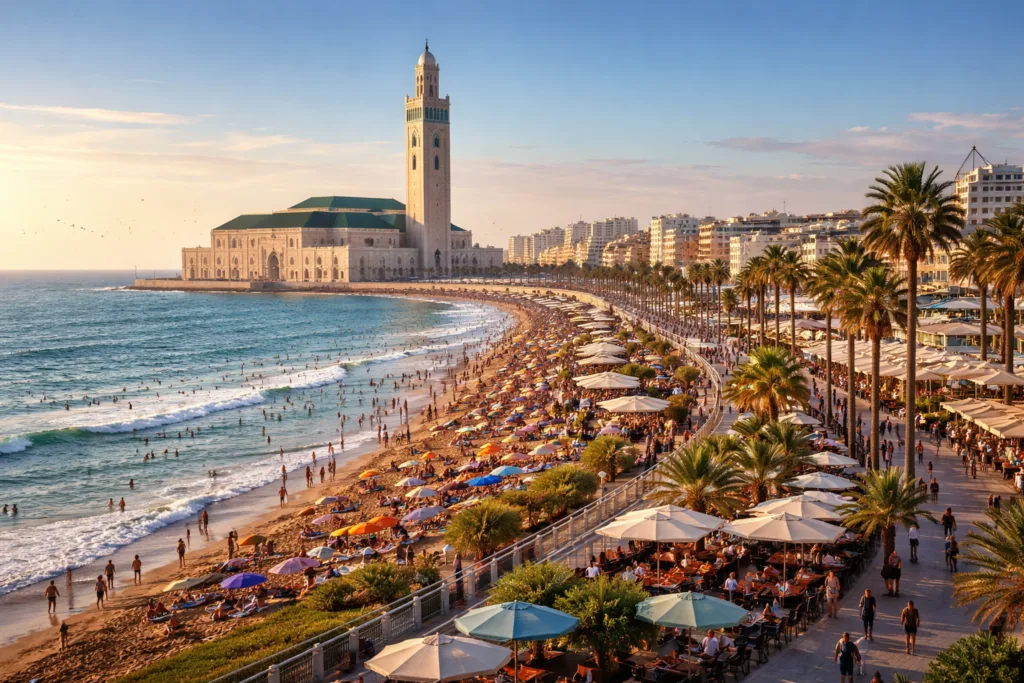
Casablanca rewards travelers who want more than a postcard version of Morocco. In summer 2026, the city feels especially compelling: Atlantic light softens the edges of the business capital, late afternoons invite long walks by the ocean, and its mix of Art Deco avenues, historic quarters, contemporary dining, and major cultural events creates a dynamic urban break for international visitors.
This is the Morocco of contrasts. You can admire monumental craftsmanship at the Hassan II Mosque in the morning, browse ceramics and leather goods in Habous by lunch, pause for coffee in a palm-lined boulevard café in the afternoon, and finish the day with sea air on the Corniche. For travelers who enjoy cities with rhythm, texture, and real local life, Casablanca offers depth that grows richer the longer you stay.
Casablanca remains Morocco’s commercial powerhouse, but for visitors it is also a rewarding gateway into architecture, food, design, nightlife, and Atlantic culture. Rather than trying to compete with Marrakech or Fes on medina romance, Casablanca stands apart through scale, energy, and a fascinating balance between tradition and forward motion.
| Key Point | Quick Take |
|---|---|
| Why go | Casablanca is ideal for travelers who want ocean views, architecture, culture, shopping, and a more contemporary side of Morocco in summer 2026. |
| Best experiences | Hassan II Mosque, Habous Quarter, Art Deco center, the Corniche, cafes, galleries, and easy day trips. |
| Summer mood | Long evenings, lively waterfronts, major cultural events in June and July, and a city atmosphere that feels active without being one-dimensional. |
| Best for | First-time Morocco travelers, architecture lovers, food-focused visitors, cruise stopovers, and travelers building a wider route through the country. |
| Suggested stay | 2 to 3 days gives enough time for the highlights, neighborhoods, food, and one nearby excursion. |
One of Casablanca’s strengths is that it works on multiple levels. It is a practical arrival city with strong transport links, a destination in its own right for travelers interested in modern Moroccan identity, and a comfortable base for exploring other coastal and imperial cities. If you approach it with curiosity rather than expecting a museum-like old town, it becomes one of the country’s most rewarding urban experiences.
Why Casablanca Stands Out for International Tourists
Casablanca is often described as Morocco’s most modern city, but that shorthand misses the point. What makes it memorable is not modernity alone, but the way different layers of Morocco coexist here. French-era boulevards, post-independence ambition, Islamic craftsmanship, business culture, seaside leisure, and everyday local routines all overlap in a city that feels lived in rather than staged.
For international tourists, that creates a different kind of visit. Marrakech dazzles. Chefchaouen charms. Fes immerses. Casablanca, by contrast, reveals how Morocco functions now. It is excellent for travelers who love architecture, street observation, café culture, and cities where local life is still the main event. It also suits people who want a softer transition into Morocco before heading onward to more intense destinations.
An Atlantic City with Cultural Range
The ocean gives Casablanca an identity all its own. Around Ain Diab and the Corniche, the mood shifts from businesslike to breezy, especially toward sunset. The shoreline is not just about beaches; it is about promenades, sea views, cafés, pools, clubs, restaurants, and evening strolls that make the city feel open and social.
A Better City Than Its Stereotype
Some travelers treat Casablanca as a one-night transit point. That is a mistake. Give it time, and the city starts to reveal its best qualities: monumental architecture, rewarding neighborhoods, good shopping, polished hotels, strong dining options, and a more grounded interaction with Moroccan urban life. It may not aim to be romantic in the obvious sense, but it becomes memorable through atmosphere, detail, and contrast.
Top Attractions and Best Experiences
Hassan II Mosque
The undisputed highlight of Casablanca is the Hassan II Mosque. Set dramatically on the Atlantic edge, it combines scale, craftsmanship, and location in a way that is hard to forget. Even travelers who arrive skeptical about Casablanca often leave deeply impressed by the carved wood, zellige, stonework, and sheer spatial drama of the complex. It deserves a proper visit, ideally earlier in the day before the city fully heats up.
Habous Quarter and the Everyday Elegance of the City
If you want a gentler, more curated shopping and strolling experience than a chaotic old medina, Habous is one of the smartest places to spend time. Bookshops, pastry shops, arcades, artisans, and traditional architecture give the quarter an inviting rhythm. It is particularly good for travelers who want to buy gifts without pressure and combine light shopping with photography and snack stops.
Old Medina, Downtown, and Art Deco Streets
The Old Medina is smaller and less theatrical than those in Fes or Marrakech, but that is part of its appeal. It works best when explored slowly, with attention to textures, gates, local shops, and the transition between old streets and the wider downtown fabric. Nearby, central Casablanca opens into one of the most interesting Art Deco urban landscapes in North Africa. Walk around Place Mohammed V, Boulevard Mohammed V, and surrounding avenues, and you begin to understand how the city built its identity.
The Corniche, Ain Diab, and Late-Day Casablanca
For many visitors, Casablanca makes the most sense in the late afternoon and evening. The Corniche is where you feel the city unwind: families out for a stroll, young locals meeting friends, ocean-facing restaurants filling up, and a more relaxed pace settling in after the daytime rush. During the summer season 2026, this part of the city is one of the best places to experience Casablanca’s social side.
Summer Events in Casablanca
Casablanca has a strong urban event culture, and June and July are especially lively. For travelers who enjoy building a trip around concerts, comedy, or cinema, the city offers more than sightseeing. Here are some of the standout events currently confirmed or announced for the city in 2026:
- Comediablanca 2026 — June 4, 2026. A comedy-focused event bringing together Moroccan and international humor acts.
- Casablanca Arab Film Festival 2026 — June 5 to June 12, 2026. A dedicated Arab cinema festival that adds a cultural edge to an early-summer city break.
- Nostalgia Lovers Festival 2026 — June 18 to June 20, 2026. A music event built around iconic hits and crowd-pleasing live nostalgia.
- Jazzablanca 2026 — July 2 to July 11, 2026. One of the city’s flagship festivals, mixing jazz and contemporary music in a cosmopolitan setting.
If your dates fall later in July or August, it is still worth checking local listings closer to departure. Casablanca’s summer calendar often expands with club programming, pop-up evenings, and venue-specific events that are announced nearer the time.
What Recent Summer Visitors Liked About Casablanca
Reliable travel content should not rely only on official descriptions. It should also reflect what recent visitors actually felt on the ground. Looking across recent summer traveler feedback, a few themes appear again and again.
- The mosque consistently exceeds expectations. Summer visitors repeatedly describe the Hassan II Mosque as the essential Casablanca experience, praising both the scale of the building and the richness of its interior detail.
- Local warmth improves the city experience. Travelers who explored the Old Medina in July highlighted that people were polite, helpful, and easier to engage with than they had expected before arrival.
- Guided visits help the city click. Night tours, city tours, and food tours received especially positive feedback from visitors traveling in July and August, who appreciated knowledgeable local guides that connected history, neighborhoods, and contemporary culture.
- Casablanca rewards travelers who look beyond clichés. Families, couples, and groups who gave the city more than a quick stop tended to come away describing it as friendly, informative, atmospheric, and surprisingly enjoyable.
That does not mean Casablanca is for everyone in the same way. It is best for travelers who enjoy urban texture, not just headline landmarks. But the positive pattern is clear: when visitors combine the mosque, a well-chosen neighborhood walk, good food, and local insight, the city leaves a strong impression.
Day Trips and Easy Extensions
Casablanca becomes even more useful when you see it as part of a wider route. Because it is so well connected, you can enjoy the city and still add nearby destinations without overcomplicating your itinerary.
Rabat
Rabat is the easiest and most elegant extension. Morocco’s capital offers broad avenues, major monuments, ocean views, and a calmer rhythm than Casablanca. Together, the two cities make an excellent dual-city stay for travelers who want modern Morocco, heritage, and the coast in a compact format.
El Jadida and Azemmour
Head south and you can swap big-city energy for a slower coastal mood. El Jadida brings Portuguese heritage and sea-facing walls, while Azemmour offers a more intimate historic atmosphere with artistic touches and river views. Both work well if you want a softer, photogenic counterpoint to Casablanca.
Bouskoura Forest
Travelers staying a little longer may appreciate a greener pause at Bouskoura Forest, especially if they want a break from dense urban movement. It is not a headline international attraction, but it is a pleasant local option for a slower morning or active outing.
Practical Tips for Visiting Casablanca
Casablanca is one of Morocco’s easiest cities to navigate with a bit of planning. The tram is useful for many urban movements, petit taxis work well for shorter hops, and walking makes sense in selected districts such as downtown, Habous, the Marina area, and parts of Ain Diab. This summer, the smartest strategy is to organize your sightseeing around the light: start major visits earlier, slow down in mid-afternoon, and save the waterfront for later in the day.
Where to Stay
For first-time visitors, central Casablanca is convenient for architecture, restaurants, and business-style hotels. Gauthier and Maarif are good for dining and city energy. The Marina area suits travelers who want a polished setting near the mosque and ocean views, while Ain Diab is best for a resort-like atmosphere, seaside dining, and nightlife access.
What to Wear and How to Plan Your Day
Casablanca is more relaxed in dress than some travelers expect, but respectful clothing is still the best choice, especially when visiting religious or traditional areas. Light, breathable layers work well. Comfortable shoes matter more than fashion if you plan to combine downtown walking, medina lanes, and the waterfront in one day. A hat, sunglasses, and water are useful essentials.
How Many Days Do You Need?
One full day covers the headline sights. Two days feels balanced and satisfying. Three days is ideal if you want to add better meals, slower neighborhood exploration, shopping, nightlife, or a day trip. Casablanca is not a city you need to rush unless your wider Morocco route leaves you no choice.
Conclusion
Casablanca is not trying to be a fantasy version of Morocco, and that is exactly why it deserves your attention. It offers architecture, ocean atmosphere, urban energy, local life, and a cultural calendar that can make a short stay feel unexpectedly rich. If you are planning a Moroccan city break or building a larger national itinerary, Casablanca can be both a smart gateway and a genuinely rewarding destination in summer 2026.
And when you are ready to keep planning, subscribe to our newsletter by entering your email address in the field at the bottom of the page. It is the easiest way to get fresh Morocco travel inspiration, practical advice, and new destination ideas delivered straight to your inbox.
FAQ
Is Casablanca worth visiting in July or August?
Yes, especially if you enjoy architecture, food, and contemporary city life. Casablanca works well in midsummer because the oceanfront becomes particularly enjoyable in the late afternoon and evening, and the city often has cultural programming during June and July.
How many days should I spend in Casablanca?
Most travelers should plan for 2 days. That gives you enough time for the Hassan II Mosque, Habous, downtown architecture, the Corniche, and at least one strong meal or evening outing without rushing.
Can non-Muslim visitors enter the Hassan II Mosque?
Yes, the mosque is one of the best-known religious sites in Morocco that can be visited by non-Muslims during organized visiting times. It is wise to check current access details before your visit and dress respectfully.
What area is best for staying in Casablanca?
It depends on your travel style. Central districts are practical for sightseeing and restaurants, the Marina area is polished and scenic, and Ain Diab is best if you want sea views, beach clubs, and nightlife nearby.
Is Casablanca mainly a sightseeing city or a beach city?
It is better understood as a sightseeing and lifestyle city with an Atlantic waterfront. The Corniche is excellent for atmosphere, walking, dining, and sunset views, while the city’s overall appeal comes more from its neighborhoods and cultural mix than from a classic resort beach experience.
What should I wear in Casablanca in summer?
Choose breathable, comfortable clothes that feel respectful in public settings. Light trousers, skirts or dresses with coverage, relaxed tops, and walking shoes are practical choices, especially if you plan to move between religious, historic, and seaside areas in one day.
What summer events should I look for in Casablanca?
Major early-summer highlights include Comediablanca, the Casablanca Arab Film Festival, the Nostalgia Lovers Festival, and Jazzablanca. Event calendars can expand closer to departure, so check the official city listings again before your trip.
Is Casablanca a good base for day trips?
Yes. Rabat is the easiest high-value day trip, while El Jadida and Azemmour offer coastal alternatives with a slower rhythm. That makes Casablanca a practical anchor for a broader west-coast itinerary.