
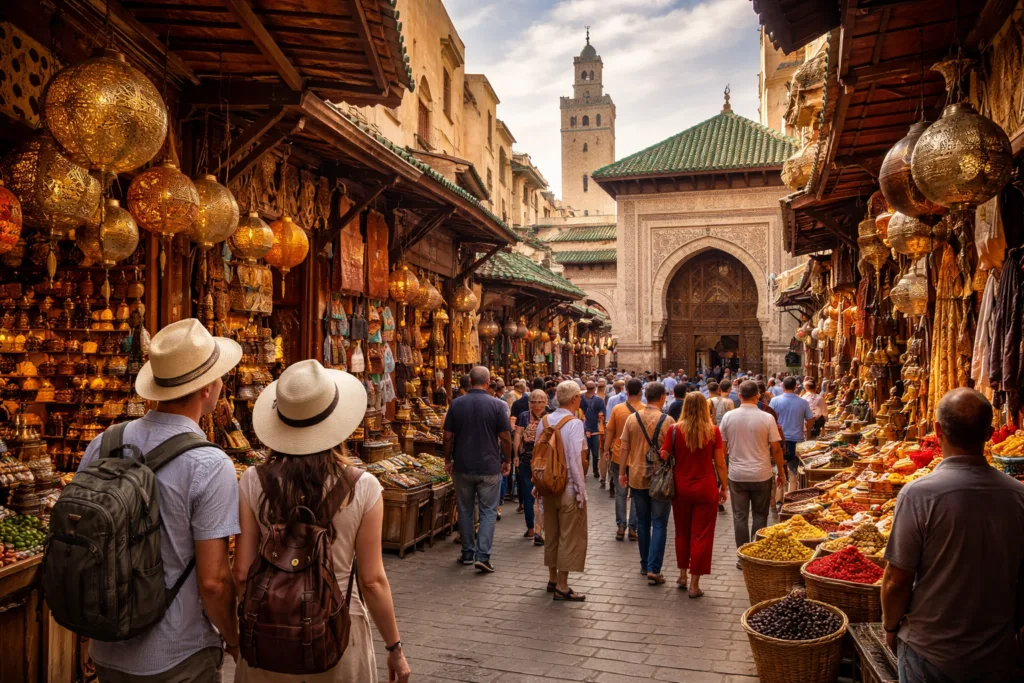
Fes Medina is one of the most rewarding places to explore in Morocco, and for summer 2026 it remains an essential stop for travelers who want more than a quick photo opportunity. Hidden behind monumental gates and wrapped in centuries of memory, this living maze of alleys, workshops, prayer calls, carved doorways, and market stalls offers a journey into the oldest urban heart of the country. As a UNESCO World Heritage site, it is not simply a beautiful historic quarter. It is a place where craft, religion, scholarship, trade, and everyday life still meet in a way that feels immediate and unforgettable.
A Fes Medina tour is especially appealing for visitors who want to understand the deeper layers of Moroccan culture while moving through one of the most atmospheric urban landscapes in North Africa. Instead of seeing Fes only from the outside, a good tour helps you notice the details that many independent visitors miss: the rhythm of artisan neighborhoods, the symbolism in religious architecture, the social life of the souks, and the hidden courtyards behind modest facades. If you are planning a Morocco itinerary focused on heritage, craftsmanship, and authentic city experiences, this activity deserves a prime place on your list.
For readers who want the essentials at a glance, the summary below highlights the key points of the experience in a format that is easy to scan on mobile.
| Key Point | What to Know |
|---|---|
| Why go | Fes Medina offers history, craftsmanship, architecture, and daily local life in one immersive walking experience. |
| Best timing | For summer 2026, early morning or late afternoon tours are the most comfortable and photogenic. |
| Ideal duration | Plan around 3 to 4 hours for a solid introduction, or longer if you want museum stops, shopping, or food breaks. |
| Main highlights | Al-Qarawiyyin, Bou Inania Madrasa, Chouara Tanneries, artisan souks, historic gates, and hidden lanes. |
| What to wear | Light, breathable clothing, comfortable walking shoes, sun protection, and modest attire for cultural respect. |
| Guided or solo | A guided tour is best for first-time visitors because the medina is large, intricate, and filled with stories that are easy to miss alone. |
| Best for | Culture lovers, photographers, history enthusiasts, families with older children, and travelers seeking authentic Moroccan city life. |
Historical Significance of Fes Medina
Few places in Morocco concentrate so much history into such a compact and vivid space. Fes Medina, often referred to as Fes el-Bali, emerged in the early Islamic centuries and grew into one of the most influential urban centers of the western Muslim world. Dynasties, scholars, merchants, theologians, craftsmen, and travelers all left their mark here. What makes the medina remarkable is not only its age, but the fact that it continues to function as a living city rather than an open-air museum.
Walking through its streets, you encounter layers of history that still shape the present. The layout of neighborhoods, the presence of fountains and mosques, the organization of commercial streets, and the continuity of artisanal trades all reveal a city whose identity has been preserved through use rather than reconstruction. That continuity is one of the great reasons a medina tour feels so meaningful: you are not looking at ruins, but entering an environment that still breathes.
UNESCO World Heritage Site
The UNESCO designation matters because Fes Medina represents one of the most complete historic urban fabrics in the Arab-Muslim world. Its gates, mosques, madrasas, fondouks, artisan districts, homes, and market streets together create a rare urban ensemble. For visitors, that recognition is more than a label. It helps explain why so many corners of the medina feel architecturally coherent even when they seem chaotic at first glance.
Morocco’s Spiritual Capital
Fes has long held a special place in Morocco’s spiritual and intellectual life. It became a center of learning, religious debate, manuscript culture, and refined urban tradition. Even after political power shifted elsewhere, the city retained a prestige linked to scholarship, craftsmanship, and faith. That is why many travelers describe a tour of Fes Medina as less flashy than Marrakech but, in some ways, more profound. The beauty here is quieter, more intricate, and often more rewarding over time.
What to Expect on a Fes Medina Tour
A Fes medina tour is best approached as a layered walking experience rather than a checklist of monuments. You move through commercial streets full of spices, lamps, leather goods, ceramics, and fabrics, then suddenly enter calmer passages where carved doors, old houses, and small fountains create a more intimate atmosphere. The medina constantly shifts in tone. One minute it is noisy and theatrical, the next it feels almost hidden and contemplative.
For the summer season 2026, the smartest approach is to choose a tour that starts early or resumes later in the day, giving you the best balance of comfort, light, and energy. You should expect a moderate amount of walking, uneven ground in some sections, occasional stairs, and plenty of sensory stimulation. Bring water, keep your phone charged, and allow yourself to slow down. Fes reveals itself best when you observe rather than rush.
Exploring Souks and Workshops
One of the great pleasures of the tour is seeing how specialized neighborhoods still shape the experience of the city. Instead of a single generic market, Fes Medina offers a sequence of souks with different identities. In some lanes you will find perfume sellers and spice merchants; in others, brass workers, leather craftsmen, wood carvers, or sellers of traditional textiles. Visiting workshops for pottery, metalwork, and leatherwork adds another dimension, because you begin to understand the labor, patience, and precision behind what is sold in the souks.
Good guides often explain how materials are sourced, how skills are transmitted within families, and how tourism affects the survival of traditional crafts. That context turns shopping from a simple transaction into part of the learning experience. Even if you do not plan to buy much, these artisan stops are among the most memorable parts of the route.
Sensory Experience in the Medina
Fes Medina is not a place you only see. It is a place you hear, smell, and feel. You notice footsteps echoing on stone, the clink of metalwork, the scent of cedar, mint, and leather, the coolness of shaded alleys, and the sudden brightness of open courtyards. That sensory richness is exactly why a tour here stays in the memory. It feels immersive in a way that many historic districts no longer do.
Top Attractions within Fes Medina
Although much of the medina’s charm lies in ordinary streets and hidden passages, a few landmarks give structure to the visit and help first-time travelers understand the city’s importance. These are not isolated monuments disconnected from their surroundings. They are part of a larger urban and cultural system that still defines the identity of Fes.
Al-Qarawiyyin University and Mosque
Al-Qarawiyyin is one of the most symbolically important places in the city. Founded in the ninth century, it is widely associated with one of the oldest continuously operating centers of learning in the world. The surrounding area is dense with spiritual and intellectual history. Non-Muslim visitors generally admire the site from outside or from select vantage points nearby, but even from the exterior, the atmosphere around it gives a strong sense of the medina’s scholarly prestige.
Bou Inania Madrasa
The Bou Inania Madrasa is often one of the most visually impressive stops on the tour. Its carved stucco, cedar wood, geometric tilework, and harmonious proportions demonstrate the refinement of Marinid architecture at its peak. For many visitors, this is the moment when the artistic sophistication of Fes becomes unmistakable. It is also one of the best places to pause, look closely, and appreciate how Moroccan decorative traditions combine mathematics, craftsmanship, and spirituality.
The Tanneries of Fes
No visit to the medina feels complete without seeing the famous tanneries. The Chouara Tannery remains one of the most iconic images of Fes, with its circular stone vats, traditional dyeing methods, and dramatic rooftop viewpoints. Yes, it is a popular stop, but it earns that popularity. The scene is visually striking, historically important, and unlike almost anything most travelers have seen before. It is also a reminder that in Fes, old trades are not abstract heritage. They are still practiced in real working spaces.
Together, these attractions offer a compelling overview of the fes medina highlights while encouraging you to pay attention to the ordinary lanes in between, where much of the magic truly lives.
Local Markets and Artisans
For many travelers, the markets are where Fes feels most alive. They are not only places of commerce but also spaces of performance, conversation, and continuity. Shopkeepers greet passersby, craftsmen work behind counters, and every object seems to carry a trace of local knowledge. Even when tourism is present, the medina never feels entirely staged. That authenticity is part of its appeal.
Famous Souks of Fes Medina
Souk el Attarine is often remembered for its perfumes, spices, oils, and warm colors, while Souk Seffarine is known for metalwork and the rhythmic energy of hammering artisans. As you move from one area to another, the atmosphere changes, giving you a better sense of how the medina functions as a patchwork of specialized craft and trade zones. These are the kinds of details that make the city feel both complex and coherent.
Traditional Craftsmanship in Fes
- Leatherwork: Fes is known for bags, slippers, jackets, poufs, and finely crafted accessories made through techniques associated with the city’s historic tanneries.
- Pottery and zellige: Ceramic work remains one of the artistic signatures of Morocco, and Fes is a wonderful place to see both utilitarian pottery and decorative tile traditions.
- Metalsmithing: Brass and copper workshops reveal extraordinary hand skills, from trays and teapots to lamps and ornamental details.
- Textiles and embroidery: Fabrics, scarves, caftan materials, and woven items show the medina’s deep link to color, texture, and ceremonial life.
For travelers who care about buying something meaningful rather than generic souvenirs, Fes is one of the strongest destinations in Morocco. A thoughtful guide can also help you distinguish between handmade pieces, workshop products, and mass-produced items.
Exploring the Labyrinth of Alleyways
Part of what makes the medina extraordinary is also what makes it challenging: it is vast, intricate, and easy to misread. The alleys branch unexpectedly, names are not always obvious to visitors, and visual repetition can make orientation difficult. Yet that same complexity is the source of the medina’s romance. You are constantly turning corners into places that feel half secret.
Tips for Navigating the Medina
- Start with a clear meeting point and note the nearest gate or landmark before entering deeply into the medina.
- Wear comfortable shoes with good grip, as surfaces can vary between smooth stone, worn steps, and narrower passages.
- Keep small cash available if you plan to shop, tip a guide, or buy snacks along the way.
- Use a local guide on your first visit if you want stronger historical context and a more relaxed experience.
The Charm of Getting “Lost”
Even though most visitors worry about getting lost, a little disorientation is part of the pleasure. Some of the most memorable moments happen in quiet side streets, at hidden viewpoints, or outside tiny workshops you would never find if you followed only the obvious route. The key is to get pleasantly lost, not stressfully lost. That is where good pacing and light preparation make all the difference.
Guided Tours vs. Exploring Independently
Both options can be enjoyable, but they offer very different experiences. Exploring independently gives you freedom and spontaneity. You can stop when you like, photograph what interests you most, and wander without a schedule. However, many first-time visitors discover that without context, they miss much of what makes Fes remarkable. Beautiful doors remain just doors; artisan districts become anonymous; major sites pass by without explanation.
A guided tour is especially valuable this summer because it helps you use your cooler hours wisely, avoid unnecessary backtracking, and focus on the places most worth your energy. Guides also make it easier to understand etiquette, negotiate the pace of the route, and connect the city’s architecture, religion, commerce, and social customs into a coherent story. For many travelers, the ideal formula is to start with a guided visit and later return alone to favorite areas.
Cultural Etiquette in Fes Medina
Fes Medina rewards curiosity, but it also asks for sensitivity. This is not only a tourist district. It is a lived-in environment shaped by faith, family, work, and long-standing local norms. Dressing modestly is wise, especially if you plan to visit religiously significant areas or more conservative neighborhoods. Lightweight trousers, longer skirts, loose shirts, and clothing that covers shoulders are practical and respectful choices.
Dress Code and Respect for Sites
Modest dress tends to make the experience smoother and more comfortable. It reduces unwanted attention, shows cultural respect, and suits the atmosphere of the medina. Hats, sunglasses, and breathable fabrics are useful, but avoid turning the tour into a beach-style outing. Fes feels more elegant than casual, and many travelers enjoy matching that mood with neat, practical clothing.
Interacting with Locals
Be polite when taking photos, especially near workshops or in quieter residential sections. Ask before photographing people closely. In the souks, bargaining is normal, but courtesy matters. Smile, keep the tone light, and do not treat negotiation like a battle. A respectful attitude usually leads to warmer interactions and a more rewarding visit overall.
What Summer Travelers Often Praise About the Experience
Visitors who tour the medina during the warmer months often highlight a similar set of positive impressions. Rather than focusing only on famous monuments, they tend to remember the quality of the atmosphere and the feeling of moving through a place that still has real urban life. Commonly praised aspects include:
- The early-morning mood: many travelers love how the medina feels calmer, cooler, and more photogenic before the busiest part of the day.
- The human side of the tour: visitors frequently appreciate guides who explain not just dates and names, but also how local families, artisans, and merchants shape the city today.
- The craft encounters: seeing leather, metal, wood, and ceramics connected to real working spaces often becomes one of the most memorable parts of the visit.
- The contrast between energy and calm: travelers often mention how quickly the medina shifts from lively souks to serene corners, making the walk feel varied and deeply atmospheric.
That pattern of feedback says a lot about why the activity remains so compelling. The medina is not enjoyed only as a sightseeing route. It is enjoyed as an encounter with a living city whose identity still feels intact.
Conclusion
A Fes Medina tour offers far more than a walk through old streets. It gives you access to one of Morocco’s richest cultural landscapes, where scholarship, faith, craft, architecture, and daily urban life continue to exist side by side. For travelers planning a Morocco itinerary for summer 2026, it remains one of the most rewarding ways to understand the country beyond postcard images.
If you approach it with curiosity, good timing, comfortable shoes, and respect for the local rhythm, the medina can become one of the defining memories of your trip. Whether you are drawn by history, artisan traditions, photography, or the simple pleasure of exploring a city that still feels intensely alive, Fes rewards attention at every turn.
If you enjoyed this guide and want more inspiration for planning your trip across Morocco, subscribe to our newsletter by entering your email address in the designated field at the bottom of the page. It is the easiest way to receive fresh destination ideas, practical travel tips, and new cultural experiences to add to your itinerary.
FAQ
Is a Fes Medina tour worth booking in summer 2026?
Yes. A Fes Medina tour can be an excellent choice in summer 2026 as long as you plan it at the right time of day. Early morning and late afternoon visits are usually the most comfortable, and a guided route helps you focus on the most interesting sites without wasting energy.
What time of day is best for visiting the medina?
For the best experience in summer 2026, aim for a start between about 8:00 and 10:00 in the morning, or choose a later visit after the strongest midday heat begins to ease. The light is also softer for photos, and the pace feels more enjoyable.
How long should I plan for a Fes Medina tour?
Most travelers should allow 3 to 4 hours for a satisfying introduction. If you want time for artisan stops, shopping, a cultural site visit, and a relaxed tea break, you may prefer a longer half-day format.
Do I need a guide, or can I visit independently?
You can explore alone, but many first-time visitors find that a guide is especially helpful this summer because the medina is large and easy to navigate inefficiently. A knowledgeable local guide saves time, adds cultural context, and helps you enjoy the walk more comfortably.
What should I wear and bring for the tour?
Wear breathable, modest clothing and comfortable closed shoes or supportive sandals. Bring water, sunglasses, sun protection, and a small amount of cash. A light bag is better than heavy luggage because some lanes are narrow and crowded.
Is the activity suitable for families and older travelers?
Yes, in many cases it is. During the summer season 2026, families and older travelers usually enjoy the experience most when they choose a shorter route, book a guide, and avoid the hottest hours. A slower pace makes the medina much more comfortable and enjoyable.