
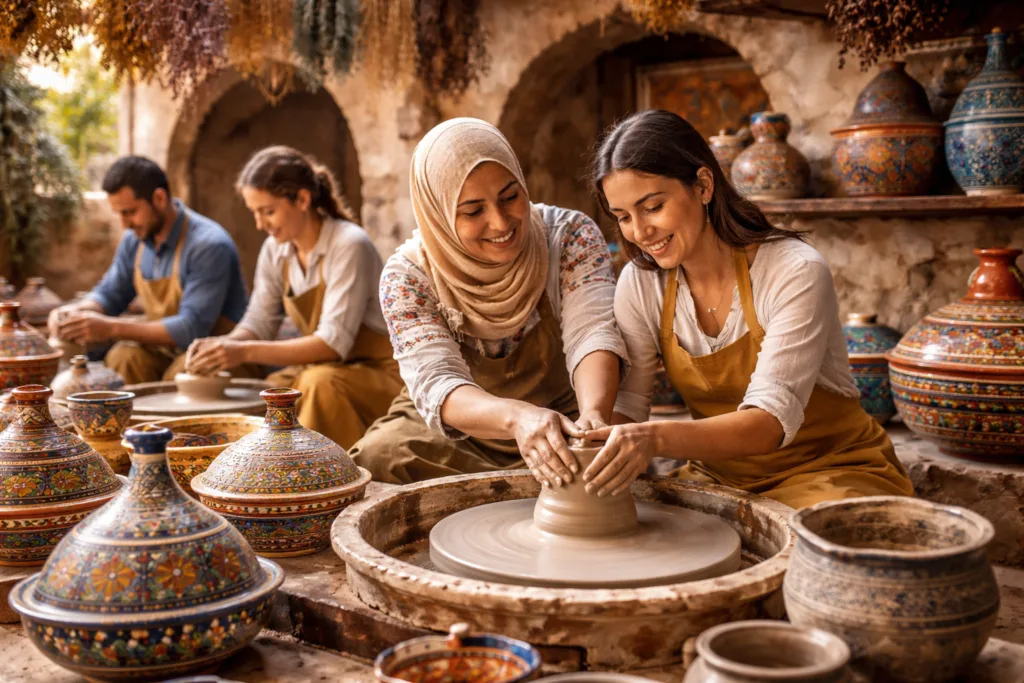
If you are planning a cultural escape in Morocco for summer 2026, a pottery workshop is one of the most rewarding ways to move beyond sightseeing and step directly into the country’s living craft traditions. In cities such as Fes and Safi, and in smaller artisan communities farther south, clay is still shaped by hand, glazed with care, and fired using methods that connect today’s makers with generations of masters. For international visitors, this is not just an activity to fill an afternoon. It is a chance to slow down, meet local artisans, understand the rhythm of the workshop, and create something meaningful with your own hands.
What makes a Moroccan pottery experience special is the combination of beauty, technique, and hospitality. You are not simply shown a finished object on a shelf. You are invited to touch the clay, watch a wheel spin, learn why one region favors blue decoration while another is known for green glaze, and hear the stories behind the forms used in Moroccan homes for cooking, serving, and decoration. Even travelers with no artistic background often leave surprised by how quickly the process becomes absorbing.
For couples, solo travelers, families with older children, and culture-focused visitors, this kind of workshop offers something increasingly rare in modern travel: genuine participation. Instead of rushing from one landmark to the next, you spend time in a creative space where gestures, tools, and materials all have meaning. Whether you paint a small bowl, shape a tagine lid, or try your hand at a decorative tile, the memory tends to stay with you longer than any shop-bought souvenir.
Below, you will find a complete guide to what a Moroccan pottery workshop really involves, where to go, what you can expect on the day, how this art fits into the country’s wider heritage, and why so many travelers rank it among their most memorable experiences in Morocco.
| Key Point | What You Need to Know |
|---|---|
| Why do it? | It is one of the most immersive cultural activities in Morocco, combining craft, conversation, and creativity. |
| Best places | Fes for blue ceramics and workshop visits, Safi for ceramic heritage, and Tamegroute for distinctive green pottery. |
| Typical duration | Most sessions last from 1.5 to 4 hours, while immersive craft stays can last several days. |
| Good for | Beginners, art lovers, couples, families, and travelers looking for meaningful local experiences. |
| Timing tip | For summer 2026, morning or late-afternoon sessions are usually the most comfortable and photogenic. |
| Take-home value | You leave with more than an object: you gain a deeper understanding of Moroccan culture and the work behind its crafts. |
History of Moroccan Pottery
Moroccan pottery is one of the country’s oldest and most expressive crafts. Long before modern tourism turned ceramics into sought-after souvenirs, clay vessels were part of daily life across Morocco. They stored water, cooked food, carried grain, and decorated homes. Over time, practical needs evolved into aesthetic traditions, and each region began to develop forms, glazes, motifs, and firing methods that reflected local materials and cultural influences.
What makes Moroccan pottery especially fascinating is that it is not a single uniform tradition. It is a conversation between Amazigh heritage, Andalusian refinement, Islamic geometry, rural utility, and urban artistry. In some places, pottery remains closely linked to household function; in others, it becomes a vehicle for elaborate decoration, symbolic patterns, and refined craftsmanship meant for architecture and display. This range is part of what makes a hands-on workshop so rewarding for travelers: you are stepping into a craft that is both ancient and still evolving.
Ancient Traditions and Techniques
Many of the gestures used in Moroccan workshops today feel timeless. Clay is kneaded to remove air pockets, centered on the wheel or shaped by hand, trimmed with simple tools, left to dry, and then decorated before firing. In more traditional settings, you may still see methods that emphasize touch and repetition rather than mechanized speed. That is one reason pottery workshops in Morocco feel so intimate: the artisan’s hand remains visible in every stage.
Decorative traditions are equally rich. Geometric compositions, floral patterns, calligraphic influences, and earthy or mineral-based glazes all contribute to a visual language that is immediately recognizable yet regionally diverse. In cities shaped by Andalusian artistic heritage, ceramic work often becomes more intricate and architectural, closely related to the world of zellige, carved plaster, and ornate interiors.
For visitors, a workshop reveals that pottery is not only about shaping clay. It is about precision, patience, drying time, balance, and surface treatment. Even a simple bowl teaches you how much control is required to create something that looks effortless.
Regional Variations of Moroccan Pottery
Different regions in Morocco have their own pottery traditions. Safi is one of the country’s best-known ceramic centers and remains strongly associated with quality pottery and decorative pieces. Fes is celebrated for the famous blue ceramic style often connected with the city’s artisanal identity, while Tamegroute, near Zagora, stands out for its distinctive green pottery that has become iconic in southern Morocco.
These variations matter because they shape the experience you will have as a traveler. A workshop in Fes may introduce you to refined decoration and close links with mosaic traditions. A stop near the Sahara Desert may expose you to a more rustic, earthy style rooted in local materials and desert culture. Safi, meanwhile, gives visitors a strong sense of Morocco’s ceramic legacy at the scale of an entire city. If your itinerary allows, comparing more than one pottery center can deepen your understanding of how local identity is expressed through clay.
What to Expect from a Moroccan Pottery Workshop
For travelers visiting Morocco this summer, a pottery workshop offers a refreshing balance to busy medina walks, long sightseeing days, and road-trip itineraries. Most experiences begin with a short introduction to the studio, the materials, and the artisan’s background. You may first watch a demonstration and then move on to your own hands-on session. In smaller workshops, the atmosphere often feels informal and welcoming, with plenty of time for questions, photos, and conversation.
Expect to get your hands dirty. Even painting-focused sessions usually include contact with raw or semi-finished clay. That tactile element is part of the pleasure. Many visitors find the workshop unexpectedly calming: the rhythm of shaping and repeating movements encourages concentration, while the artisan’s explanations make the cultural dimension come alive.
Depending on the format, the activity may include tea, a guided tour of the atelier, a look at a kiln area, and time to browse finished pieces. Some workshops let you take home a freshly decorated object; others need extra drying and firing time, which means collection or shipping options vary. It is always wise to ask in advance what is included.
Hands-On Experience with Local Artisans
The strongest part of the experience is the human one. Moroccan artisans do not just explain technique; they often explain why a form matters, why a glaze is used, or how a design relates to household life, hospitality, or local identity. That turns the workshop into a cultural exchange rather than a simple class.
Beginners are usually reassured very quickly. You do not need previous experience, artistic confidence, or special tools. Good instructors adjust the activity to your level, whether you want to try wheel-throwing for the first time, paint a decorative plate, or make a small object that can survive the journey home. Children and teens can often join, though age limits vary by studio and the use of kilns may be supervised more closely.
Because many workshops are small-group experiences, they also create space for meaningful interaction. Travelers often come away remembering the artisan’s personality as much as the object they made. That human connection is what transforms the activity from a lesson into a travel highlight.
Pottery-Making Process: From Clay to Kiln
- Begin with clay preparation, where you learn why moisture, texture, and consistency matter so much.
- Try shaping techniques such as wheel-throwing, pinching, coiling, or hand-building, depending on the workshop style.
- Move into surface decoration, where color, carving, stamping, or painting give the piece its character.
- Understand drying and firing, which are essential stages even if your finished piece is processed later by the workshop team.
- Discover how pottery is a big part of Moroccan culture, from cooking and serving to architecture and gifting.
Even when you only participate in one or two steps yourself, seeing the full journey from raw clay to fired ceramic changes the way you look at Moroccan craft. The plate or bowl in a market stall is no longer just a decorative object. You begin to understand the labor, timing, and skill behind it.
Types of Pottery You Can Create
One of the joys of these workshops is the variety of objects you can attempt. The exact options depend on the studio, the length of the class, and whether the focus is shaping, painting, or a mix of both. Some experiences are centered on beginner-friendly pieces; others invite you to work on forms inspired by classic Moroccan household ceramics.
Traditional Moroccan Designs
Many workshops invite you to explore patterns rooted in Moroccan decorative arts: repeated geometric motifs, floral arrangements, stylized borders, and color combinations inspired by the ceramics of cities such as Fes and Safi. Painting these designs is often more challenging than it looks, which makes the process all the more rewarding.
You may also learn how certain forms are linked to daily life, from serving bowls and cups to decorative dishes and tagine-inspired shapes. Even when the piece you create is small, it usually draws on a much larger visual heritage. That is part of the appeal for visitors who want an activity with cultural depth rather than a purely recreational craft class.
Creating Unique and Personalized Pieces
Alongside traditional designs, most workshops leave room for personal expression. You might choose your own color palette, add initials or a date, experiment with a simpler motif, or shape an object that feels more contemporary. This flexibility is especially appealing to travelers who want a meaningful keepsake that reflects both Morocco’s craft traditions and their own journey.
That balance between guidance and individuality is what makes pottery such a satisfying travel activity. You are not expected to become a master ceramicist in a few hours. Instead, you participate in a real artistic process and leave with something that carries both local knowledge and personal memory.
Best Places in Morocco to Take a Pottery Workshop
Morocco offers several strong destinations for travelers interested in pottery, but the best choice depends on your itinerary and the type of experience you want. Some visitors prefer an urban workshop inside or near a medina, where ceramics are part of a broader day of cultural discovery. Others look for a smaller town or village setting where pottery feels more directly tied to local daily life.
Pottery Villages and Artisan Studios
Fes is often the easiest and most rewarding choice for international travelers. The city combines major heritage attractions with access to workshops where ceramics and related crafts remain central to the local identity. A pottery class here fits naturally into a wider exploration of the medina, artisan districts, and architectural beauty of the city.
Safi is another excellent destination if pottery itself is your main focus. The city’s long-standing ceramic reputation gives visitors a stronger sense of how an entire urban identity can be linked to clay and craftsmanship. If your route includes the Atlantic coast, Safi deserves serious consideration.
Tamegroute, near Zagora, appeals to travelers heading south and looking for a more unusual artisan stop. The region’s green pottery is distinctive, and the experience pairs well with broader journeys toward palm groves, kasbahs, and desert landscapes. For travelers already exploring southern Morocco, it can add a memorable craft dimension to the trip.
Recommended Workshops for Tourists
- Short urban workshops in Fes: Ideal for travelers staying one or two nights and wanting a compact but meaningful cultural activity. These often combine demonstration, hands-on practice, and time with master artisans.
- Ceramic-focused visits in Safi: Best for travelers interested in Morocco’s broader ceramic heritage and in seeing the atmosphere of a city strongly associated with pottery.
- Southern pottery stops near Tamegroute: A strong option for visitors combining craft discovery with a journey toward the Sahara Desert.
- Private or small-group atelier sessions: Excellent for couples, families, and travelers who prefer more guidance, more interaction, and a quieter creative setting.
Whichever destination you choose, it is worth selecting a workshop that prioritizes learning and exchange over quick sales. The best experiences let you observe, ask questions, and create at your own pace rather than rushing you through a tourist performance.
Cultural Significance of Pottery in Morocco
Moroccan pottery is more than a decorative art. It reflects the country’s relationship with hospitality, domestic life, architecture, and regional identity. Bowls, dishes, jars, tiles, and serving pieces all belong to a wider world in which handcrafted objects are still valued not only for their beauty but also for their usefulness.
Pottery as a Symbol of Moroccan Heritage
Across Morocco, ceramics help express continuity. They show how old knowledge can remain relevant in modern life, and how craftsmanship continues to shape the visual character of homes, courtyards, riads, restaurants, and public spaces. A pottery workshop brings travelers closer to this heritage because it reveals the relationship between object and tradition.
When visitors see artisans painting a plate or shaping a vessel, they also begin to understand how Moroccan design language is built: through repetition, balance, patience, and attention to detail. It is one thing to admire a finished ceramic fountain or tiled wall; it is another to see the discipline behind it.
Pottery in Everyday Life and Ceremonies
Pottery still resonates because it belongs to both ordinary life and special moments. Ceramic serving ware contributes to the beauty of meals, while decorative pieces shape the atmosphere of interiors. In some contexts, pottery also carries symbolic value through motifs linked to protection, harmony, generosity, and place.
For tourists, that means the workshop is not an isolated craft class. It is a doorway into the aesthetics of Moroccan life more broadly. Once you have handled the clay yourself, you notice ceramics differently in courtyards, cafés, riads, craft shops, and family-style dining spaces throughout your trip.
What Other Tourists Loved About the Experience
During the summer season 2026, travelers continue to describe Moroccan pottery workshops as warm, personal, and surprisingly memorable. What stands out most in visitor feedback is not only the craft itself, but the patience of the artisans, the pleasure of making something with your own hands, and the sense that the activity feels authentic rather than staged.
“We expected a simple craft class and got much more.” Many visitors say they loved how clearly artisans explained each step, especially in Fes, where workshops often combine demonstration, storytelling, and hands-on practice in a way that feels accessible even to complete beginners.
“It was one of the calmest moments of our trip.” Couples and solo travelers often mention how relaxing the process feels. Working with clay creates a pause from the intensity of medina sightseeing and offers a slower, more reflective side of Moroccan travel.
“The artisans made us feel genuinely welcome.” Families and small groups frequently praise the friendliness of workshop hosts, noting that encouragement, humor, and personal attention matter just as much as the final ceramic piece.
That combination of craft, human connection, and cultural depth is why so many travelers leave saying the pottery workshop gave them a more intimate understanding of Morocco than they expected.
Conclusion
A Moroccan pottery workshop is far more than a tourist activity. It is a way to understand Morocco through touch, patience, beauty, and conversation. If you are building an itinerary for summer 2026, this is one of those rare experiences that combines culture, creativity, and genuine human exchange in a single memorable session.
You leave with a ceramic piece, yes, but also with a new appreciation for the labor behind Moroccan craftsmanship and for the artisans who keep these traditions alive. In a trip filled with iconic sights, a few quiet hours in a workshop can become the moment that feels most personal.
And if you would like more ideas for meaningful activities, practical travel tips, and inspiring destinations across Morocco, be sure to subscribe to our newsletter by entering your email address in the designated field at the bottom of the page.
FAQ
What types of pottery can I create during the workshop?
During summer 2026, most tourist-friendly workshops offer beginner-accessible pieces such as small bowls, cups, decorative plates, tagine-inspired forms, or painted ceramic items. The exact choice depends on the length of the class and whether the focus is shaping, painting, or both.
What is the pottery-making process like?
This summer, you can usually expect a short introduction, a demonstration by the artisan, your own hands-on practice with clay or decoration, and an explanation of drying and firing. Some workshops let you leave with a finished or semi-finished piece, while others complete the firing later.
Where will the workshop take place?
Most workshops take place in artisan districts, medina-adjacent studios, or family-run ateliers in pottery centers such as Fes, Safi, or Tamegroute. If you want the easiest access from a classic city itinerary, Fes is often the most practical choice.
What is the cost of the workshop, and what is included?
For the summer season 2026, prices vary widely depending on the city, duration, transportation, and whether the experience is private or small-group. In general, you should confirm in advance whether materials, tea, hotel pickup, firing, or shipping are included, because policies differ from one workshop to another.
Do I need any prior experience in pottery-making?
No. In summer 2026, this remains one of the most beginner-friendly cultural activities you can book in Morocco. Good workshops are designed for first-timers and focus as much on discovery and enjoyment as on technical perfection.