
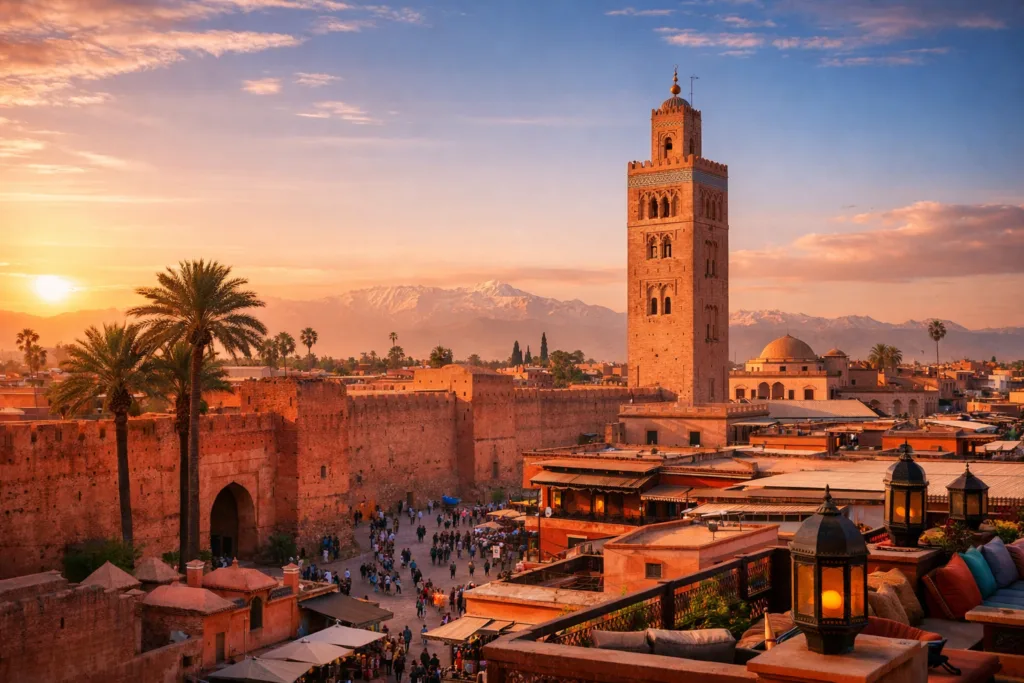
For travelers planning a Moroccan escape in summer 2026, few places feel as instantly iconic as Marrakech. Long before you step into a riad courtyard or hear the pulse of Jemaa el-Fna at dusk, the city announces itself through color. Walls, gates, alleys, and facades glow in shades of terracotta, rose, ochre, and burnt red, creating a visual identity so striking that Marrakech has become known around the world simply as the Red City.
Yet that famous hue is not a tourist slogan or a decorative trend. It is rooted in the city’s history, its traditional building materials, its climate, and its enduring urban character. For visitors coming during the warmer months, the effect can feel even more dramatic, as strong light sharpens every contour and sunset deepens every shade. To understand why Marrakech looks the way it does is to understand something essential about the soul of the city itself.
| Topic | Quick takeaway |
|---|---|
| Why Marrakech looks red | Its signature tone comes from local earth-based construction, iron-rich clay, traditional tabia building methods, and centuries of architectural continuity. |
| Historic roots | The city took shape under the Almoravids, and the medina’s famous ramparts reinforced the red identity that still defines Marrakech today. |
| What visitors notice most | The red tones appear richest around sunrise and sunset, especially along the walls, in the medina, and from rooftop terraces. |
| Best lens for summer 2026 | Think of the color as both history and atmosphere: beautiful all year, but especially vivid during early-morning and evening walks in the summer season 2026. |
| Extra cultural bonus | Summer visitors may also catch major cultural moments, including the National Festival of Popular Arts in July. |
Historical Origins – Why the Red City Began to Look This Way
An Imperial Foundation with a Strong Visual Identity
To understand why Marrakech is wrapped in warm red tones, you have to go back to the Almoravid era, when the city emerged as one of Morocco’s great imperial capitals. From its early rise as a political and commercial center, Marrakech was shaped not only by power and geography, but also by the materials immediately available around it. That practical choice created a look that became inseparable from the city’s identity.
Unlike cities whose famous colors came later through paint or regulation, Marrakech’s hue was tied to the very substance of its construction. Earth, clay, lime, and local aggregates gave the city a palette that felt natural rather than imposed. Over the centuries, that palette evolved into something symbolic: not just a way of building, but a way of recognizing Marrakech at a glance.
A City That Wears Time on Its Surface
What makes Marrakech’s red color so compelling is that it does not feel polished or artificial. It changes with weather, light, dust, age, and restoration. Some walls look pinker, others deeper and earthier, while older surfaces reveal layers of time rather than a flat, uniform finish. This gives Marrakech a lived-in beauty that feels far more authentic than a city dressed in one perfect shade.
That is also why the nickname “Red City” endures so naturally. It captures both the first impression and the deeper truth: the color is inseparable from history, material culture, and the city’s long continuity as a place of trade, belief, craftsmanship, and spectacle.
The Material Palette – Earth, Clay, and the Craft of Tabia
Local Materials Shaped the Look of Marrakech
Marrakech owes much of its famous appearance to the surrounding plain, where builders traditionally drew the earth needed for construction. The reddish character of that soil, enriched by mineral content and warmed by the desert-edge light of the region, helped produce the terracotta and ochre tones travelers still associate with the city today. In Marrakech, architecture does not fight the landscape; it seems to emerge from it.
That harmony is one reason the city feels so visually cohesive. Even when neighborhoods differ in atmosphere, the materials create a shared language. Palaces, garden walls, courtyard exteriors, alleyways, and defensive structures all seem connected by the same earth-born DNA.
Building with “Tabia” – A Traditional Technique with Lasting Power
A major part of Marrakech’s architectural identity comes from tabia, the traditional rammed-earth method long used in Morocco. Builders compacted a mixture of earth, water, and stabilizing materials into sturdy walls that were practical, adaptable, and remarkably expressive in color. The result was not only durable construction, but surfaces that carried the warm character of the surrounding land.
This technique also made sense climatically. Thick earthen walls helped regulate indoor temperatures, softening the heat during the day and preserving warmth after sunset. In a city known for strong sunshine and dry air, that balance between utility and beauty mattered enormously. The red hue, then, was never just aesthetic. It was a by-product of intelligence, local knowledge, and environmental adaptation.
Architectural Features – The Walls, the Medina, and the City’s Cohesive Glow
The Medina Walls Made the Red Identity Impossible to Miss
If one feature turned Marrakech into the Red City in the popular imagination, it was the line of ramparts surrounding the medina. These walls gave the city both defense and a powerful visual frame. Seen from afar, they announced Marrakech in one continuous, earthen sweep. Seen up close, they revealed texture, shadow, weathering, and the human hand behind the architecture.
Even today, the ramparts remain one of the clearest ways to understand Marrakech as a historic urban whole rather than a collection of monuments. They tie together gates, neighborhoods, gardens, and pathways into a single story. For visitors during summer 2026, they are especially rewarding in the early morning or around golden hour, when the light softens and the red tones appear richer rather than harsher.
Beyond the Walls, the Palette Continues
The red character of Marrakech does not stop at the fortifications. It continues through the medina’s lanes, around riad entrances, across old facades, and into landmark settings near the Koutoubia Mosque and Bahia Palace. The experience is immersive because the color is repeated at every scale, from grand exterior masses to the quiet edges of a side street.
This repetition creates one of Marrakech’s greatest visual strengths: cohesion. Many famous cities have beautiful monuments but feel fragmented. Marrakech feels unified. Its color links sacred, domestic, commercial, and defensive spaces into one atmosphere. That is part of what makes even a simple walk feel cinematic.
Why Preservation Matters So Much Here
Modern Marrakech has expanded far beyond the old city, yet its historic image remains carefully protected. The enduring reddish palette is not accidental; it survives because the city has long understood that color is part of heritage. Preserving the tone of Marrakech means preserving the visual memory of the place itself.
For travelers, that continuity is a gift. It means the Red City still feels like the Red City. Even as hotels, transport, and visitor services evolve, the emotional power of the urban landscape remains intact, allowing newcomers to encounter something genuinely rooted rather than merely reproduced for tourism.
Cultural and Natural Significance – Why the Red Feels So Alive
A Color That Suggests Warmth, Vitality, and Presence
Part of Marrakech’s appeal lies in the emotional effect of its color. Red and ochre tones can feel warm, welcoming, dramatic, and grounded all at once. In Marrakech, those feelings are intensified by the rhythm of daily life: market sounds, call to prayer, horse-drawn carriages, rooftop dining, hand-crafted objects, and the movement of people through old stone and earth passages.
The city’s palette also works beautifully with contrast. Green palms, blue skies, white details, lantern light, patterned tiles, and flowing fabrics all become more vivid against red surroundings. That visual drama helps explain why Marrakech leaves such a strong memory even after a short visit.
Why Summer Light Changes the Experience
During the summer season 2026, Marrakech’s red hue is likely to feel especially intense in the clearest parts of the day, but the most magical moments often come when the sun is lower. At sunrise, the city looks soft and powdery. At sunset, the tones deepen into something richer and almost glowing. That is when terraces, panoramic viewpoints, and slow walks near the ramparts become particularly memorable.
This summer, the smartest way to experience the Red City is not by rushing through it in the midday heat, but by timing your exploration well. Early mornings are ideal for photographing walls and alleys before crowds build. Evenings are perfect for watching how the city changes color minute by minute, shifting from dusty rose to deep amber under the fading light.
Summer 2026 Cultural Moments That Add Context to the Red City
If your trip lines up with July, Marrakech offers more than architecture. One of the most relevant cultural events for this topic is the National Festival of Popular Arts, officially scheduled from July 2 to July 6, 2026. Because it celebrates Moroccan folklore, music, dance, oral traditions, and performance in a historic Marrakech setting, it adds living cultural texture to the very cityscape that gave birth to the Red City image.
Later in the summer, Throne Day on July 30 remains one of Morocco’s fixed national holidays. While the style of local activity can vary from place to place, the date matters for travelers because it can shape the atmosphere of the country, public life, and local rhythms. In Marrakech, it can be an especially interesting moment to feel how heritage, national symbolism, and civic identity continue to animate an already historic city.
Conclusion
Marrakech is called the Red City because its appearance was never random. The color grew out of local earth, traditional building methods, imperial history, and a centuries-long commitment to preserving the city’s visual soul. That is why the red feels so convincing: it belongs to the place.
If Marrakech is on your summer 2026 itinerary, this story adds depth to every stroll you take, from the old ramparts to the quiet corners of the medina. What first appears to be a beautiful color quickly becomes something more meaningful — a living record of craft, climate, continuity, and resilience, beauty, and soul. And before you leave, subscribe to our newsletter by entering your email in the field at the bottom of the page so you can receive more Morocco travel insights, seasonal updates, and destination inspiration.
FAQ About Marrakech’s Red Hue in Summer 2026
Why is Marrakech called the Red City?
Marrakech is called the Red City because its walls, buildings, and historic facades are known for their reddish, terracotta, and ochre tones. Those colors come from traditional earth-based materials and long-established construction methods that shaped the city’s identity over centuries.
Does Marrakech still look red in summer 2026?
Yes. In summer 2026, Marrakech should still deliver the same iconic red cityscape travelers expect. In fact, the strong seasonal light can make the warm tones feel even more striking, especially at sunrise and sunset.
What makes Marrakech’s buildings look red?
The look comes mainly from traditional earthen construction, including clay-rich materials from the surrounding region and the use of tabia, or rammed-earth building techniques. Together, these give the city its warm and natural reddish appearance.
Are the medina walls the main reason people associate Marrakech with red?
They are a major reason. The medina ramparts create one of Marrakech’s strongest visual signatures and help define the city as a unified historic landscape. They make the red identity immediately visible, even before you explore deeper into the old city.
When is the best time of day in summer 2026 to see Marrakech’s red colors?
The best times are early morning and late afternoon into sunset. Midday light can feel harsh in summer, while softer light reveals more texture and richer shades across walls, gates, rooftops, and alleyways.
Is there a cultural event in Marrakech in summer 2026 that connects well with the city’s heritage?
Yes. The National Festival of Popular Arts is scheduled for July 2 to July 6, 2026, and it is an excellent cultural complement to a Marrakech visit. It highlights Moroccan folklore, music, and living traditions in a city whose historic setting already feels deeply symbolic.
Do modern buildings in Marrakech also follow the traditional red style?
Many parts of Marrakech continue to respect the city’s historic visual identity, which helps preserve the feeling of continuity between past and present. That is one reason the Red City nickname still feels relevant today rather than purely historical.
What is the best way to experience Marrakech’s red hue as a tourist in summer 2026?
Walk the medina in the morning, follow the ramparts later in the day, and end on a rooftop terrace near sunset. That combination lets you see how the city’s red palette shifts across neighborhoods and lighting conditions while avoiding the hottest part of the day.
Subscribe for More Morocco Travel Updates
Enter your email address below to receive newsletter updates, practical Morocco travel tips, and fresh destination ideas straight to your inbox.